Did you know that in Q1 2026 alone, AI companies raised an astonishing $242 billion? That figure surpassed all of 2025's venture funding for AI. This isn't just a trend; it's a fundamental shift in how we approach business. As of November 2026, Artificial Intelligence is no longer a futuristic concept; it is the core engine driving innovation, efficiency, and hyper-personalization across every industry.
For anyone asking how to start a business with AI, the answer lies in understanding and applying 'agentic AI.' This new paradigm focuses on AI systems that perform complex, multi-step tasks autonomously. It's about handing software real work, not just asking it questions, as experts emphasize. Let's look at how this is playing out in the real world.
The Agentic AI Revolution: Autonomous Workflows Take Center Stage
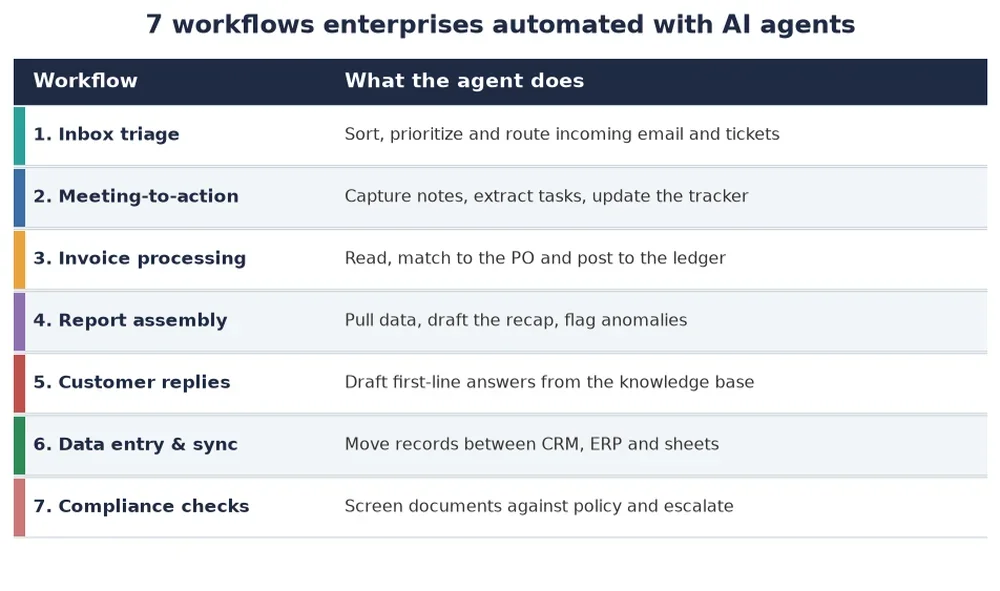
The biggest AI story in November 2026 is the move from simple task support to autonomous work orchestration. AI agents are now designed to act independently, making decisions and completing entire workflows without constant human oversight. This represents a significant leap from earlier AI applications, which often required more human intervention.
This shift is deeply integrated into enterprise software. For instance, NetSuite unveiled its vision for practical AI at SuiteWorld 2025 with 'NetSuite Next.' This platform features autonomous agents and natural language search built directly into financial workflows, allowing finance professionals to interrogate data simply by asking questions like, "What caused the variance in Q2 gross margin?" and receive instant, data-backed answers (cfoleadership.com).
Major customer service vendors have also embraced agentic AI. Salesforce enhanced its 'Agentforce' platform, Microsoft introduced 'Agent 365' and expanded 'Copilot Agents,' and Google deepened its 'Gemini-based agents.' These developments show a clear industry-wide commitment to AI systems that can independently manage and resolve customer queries.
Case Study: Agentic Innovations Inc. and OrchestratorAI
To illustrate how to start a business with AI effectively in this new environment, consider "Agentic Innovations Inc." (AII). This hypothetical, yet representative, startup launched in early 2025. It quickly capitalized on the growing trend of agentic AI, proving that new ventures can thrive by focusing on autonomous solutions.
By November 2026, AII successfully deployed its core product, "OrchestratorAI." This AI-native no-code platform lets businesses build autonomous workflows across various applications and teams. OrchestratorAI stands out by using multimodal AI pipelines, processing text, images, audio, and video to reduce content and workflow fragmentation. This capability helps businesses streamline complex processes that once required multiple disconnected tools.
OrchestratorAI integrates with existing enterprise-level AI agents, providing a customizable layer for small to medium-sized businesses. One of AII's early clients, a mid-sized e-commerce company, saw remarkable results. They used OrchestratorAI to deploy AI agents for hyper-personalization, analyzing customer behavior to deliver tailored recommendations and targeted email campaigns. This led to an 84% increase in sales and 90% faster customer service.
The AI Market Explodes: Funding, Adoption, and Industry Shifts
The growth of the AI market is truly staggering. The global Artificial Intelligence market, valued at $143.0 billion in 2025, is estimated to reach $184.7 billion in 2026 by some accounts. Other estimates are even more bullish, placing the 2025 market size at $294.16 billion, growing to $375.93 billion in 2026, or even $638.23 billion in 2025, growing by 19.20% in 2026. By November 2026, the AI market is valued at nearly $602 billion (mean.ceo).
Venture funding for AI startups has seen an explosive surge. It reached $212 billion in 2025, an 85% increase from $114 billion in 2024. As mentioned, Q1 2026 alone saw AI companies raise $242 billion, surpassing the full 2025 figure. The first nine months of 2026 continued this trend, with AI startups raising $495.6 billion, accounting for 71% of all venture capital invested worldwide during that period. A landmark event was OpenAI's $122 billion funding round, closed on March 31, 2026, at an $852 billion post-money valuation, marking the largest private funding round on record.
Adoption rates are equally impressive. In 2025, 88% of organizations worldwide reported using AI in at least one business function. By Q2 2026, nearly 19% of the world's working-age population was using generative AI.
Real-World Impact: AI Transforms Finance, Healthcare, and Customer Service
AI's influence is evident across specific industries:
- Finance: 59% of finance functions used AI in 2025. By 2026, 56% of finance leaders are using AI tools daily, a significant jump from 17% in 2023. However, 45% of finance teams remain in limited pilot mode, with only 17% running AI in core workflows (cfoleadership.com). This shows huge potential for further integration.
- Healthcare: Healthcare AI spending reached $3.7 billion in 2026, a 2.5-times increase from 2025. Healthcare providers accounted for $2.9 billion (77%) of this spending. 42% of healthcare organizations implemented industry-specific AI tools in 2026, up from 22% in 2025 (aviusai.com).
- Customer Service: AI service agent adoption increased from 39% of organizations in 2025 to 66% in 2026, according to Salesforce. Sinch reported that 62% of companies already have AI agents running in production environments. By 2026, AI is projected to touch 95% of customer interactions, with AI realistically handling 55-70% of incoming support volume without human intervention (azeon.ai).
These statistics paint a clear picture: AI is no longer optional; it's essential for competitive advantage and operational efficiency.
Why TashiOS is Your AI Business Partner for 2026
Understanding how to start a business with AI also means choosing the right tools. Many entrepreneurs and agencies find themselves stitching together AI chat, code editors, hosting, website builders, automation tools, email platforms, and client management systems. This complex setup can hinder growth and innovation.
This is where an AI-powered cloud desktop like TashiOS comes in. TashiOS is designed specifically for freelancers, entrepreneurs, agencies, and side-hustlers who want to build client-ready digital products without juggling many separate tools. It combines all the essential functionalities into one cloud workspace, running on your own private VPS.
One of TashiOS's key differentiators is its ability to help users create, sell, and manage digital products from one place. Its built-in AI assistant, Skynet, allows you to describe an app or website in plain English, and Skynet builds it for you, no coding required. This empowers non-engineers to become builders, much like the no-code AI platforms we see driving innovation today. Plus, with TashiOS, everything you build, including apps, code, and customer data, belongs to you and lives on your own server, ensuring full data control and no vendor lock-in.
Practical Steps for Starting Your AI-Powered Business Today
The insights from "Agentic Innovations Inc." and the broader market trends offer clear guidance for starting your own AI-powered venture in November 2026:
- Embrace Agentic AI: Focus on solutions that automate entire workflows, not just individual tasks. Think about how AI can orchestrate tools and complete multi-step processes autonomously.
- Use No-Code/Low-Code AI Platforms: These platforms empower non-technical founders to build powerful business automations. Look for tools that turn operators into builders.
- Prioritize Hyper-Personalization: AI allows for real-time, tailored customer journeys and offers. This moves beyond generic interactions to deeply personal experiences that drive engagement and sales.
- Integrate Embedded AI Copilots: AI is becoming the default software layer. Ensure your business uses tools that have AI copilots embedded within everyday software, from CRM to design tools.
- Focus on Value and ROI: In 2026, it's less about experimentation and more about proving what works in the real world. Companies are shifting from building their own AI agents to licensing them due to economic realities.
- Implement Responsible AI: AI governance, security, and regulation are critical. Treat responsible AI with the same gravity as financial auditing or cybersecurity.
- Develop AI Skills: AI skills are becoming core to the employee experience. Employees across all functions should be comfortable using AI tools daily. AI will also drive hyper-personalized talent management, from recruitment to performance.
- Consider Infrastructure: The energy demands of AI are a major bottleneck. Look for energy-efficient AI models and be aware of the investment in data center infrastructure.
New businesses can significantly benefit from cloud credit programs, like Google for Startups (AI tier), which offers up to $350,000 in credits over two years for Google's Gemini models and Google Cloud stack. This can provide a strong foundation for your AI initiatives.
Ready to build your own AI-powered business and capitalize on these trends? Discover how TashiOS can simplify your journey by providing a complete AI cloud desktop that runs on your private VPS, offering a predictable flat monthly cost instead of per-API-call billing. With TashiOS, your prompts and data stay on your own server, giving you full control.
The Future is Agentic: Key Takeaways for November 2026
The success of companies like Profound, an AI marketing platform that secured a $180 million Series D in 2026 at a $1.8 billion valuation, and Mistral AI, which raised €11.7 billion in September 2025, demonstrates significant investor confidence in AI-driven ventures. Even in healthcare, companies like Gong launched "Custom Agents" in June 2026, offering AI-powered assistance for sales teams (everythingtech.co.uk).
Recent news further reinforces this direction. On November 10, OpenAI launched "Businesses" in beta within ChatGPT, allowing for business profiles and business-facing agents. The same day, IBM and Microsoft announced an enterprise platform designed to connect AI agents with industry-specific processes. These developments highlight the growing emphasis on AI as a core business infrastructure.
Starting a business with AI in November 2026 means focusing on agentic, autonomous solutions that solve specific business problems. It requires integrating with existing enterprise platforms and prioritizing responsible AI implementation. The market is ripe with funding and adoption, but success hinges on practical application and a clear understanding of how AI can augment human capabilities rather than simply replace them.
The future is here, and it's agentic. Don't get left behind. Start your AI business today with a 7-day free trial at TashiOS and experience how "AI builds. You earn."