Did you know that AI companies raised an astounding $242 billion in Q1 2026 alone? That figure surpassed all of 2025's funding. If you've been thinking about getting into the artificial intelligence space, November 2026 presents an unparalleled moment. The AI business world isn't just growing; it's exploding with new opportunities, a dramatic shift towards autonomous systems, and a strong demand for specialized solutions. Here's what you need to know to start your own AI business right now.
1. Explosive Market Growth and Investment Fueling AI Ventures
The AI market is experiencing hyper-growth, attracting massive investment and creating a fertile ground for new businesses. This isn't just a trend; it's a fundamental economic shift.
The global AI market, valued at USD 390.9 billion in 2025, is estimated to reach USD 539.5 billion in 2026, according to grandviewresearch.com. Projections indicate a surge to USD 3,497.3 billion by 2033, showing a Compound Annual Growth Rate (CAGR) of 30.6% from 2026 to 2033. This remarkable expansion is backed by record investment, with global corporate AI investment more than doubling in 2025, and private AI investments jumping 127% (stanford.edu).
Generative AI, in particular, is a powerhouse, with its market valued at $55.51 billion in 2026 and projected to hit $1,206.24 billion by 2035 (articsledge.com). North America leads the charge, holding 35.5% of the global AI market share in 2025 (grandviewresearch.com). The U.S. alone commits 23 times more private AI investment than China (stanford.edu). We've also seen mega-rounds like OpenAI's $122 billion funding on March 31, 2026, at an $852 billion post-money valuation, marking the largest private funding round on record (aifundingtracker.com).
2. Agentic AI: The Rise of Autonomous Digital Workers
The conversation has moved beyond simple generative AI. The focus is now on sophisticated 'Agentic AI,' which can reason, plan, and execute complex tasks with minimal human intervention. This represents a significant leap forward in AI capabilities.
Agentic AI systems are autonomous digital workers that understand goals, plan actions, and execute workflows independently. They are not just chatbots responding to prompts; they are digital employees. Gartner predicts that by the end of 2026, 40% of enterprise applications will embed AI agents, a substantial increase from less than 5% in 2025 (secondtalent.com). Currently, 62% of organizations are already testing AI agents.
These agents are delivering tangible time savings. Case studies from Perth show a finance team gaining a week back every month, and a solar business owner saving 1 to 2 hours daily, adding up to 250 to 500 hours annually (secondtalent.com). Experts like Wipro's CTO and McKinsey analysts suggest that the agent-driven autonomous enterprise will be a tangible reality by 2026.
3. Niche is King: Specialized AI Solutions Win the Market
The market for generic AI tools is becoming crowded. To truly stand out and start your own AI business, entrepreneurs are finding success by focusing on highly specialized, vertical-specific AI solutions.
Horizontal AI tools, such as writing assistants and chatbots, are oversaturated. We've seen over 5,600 AI startups shut down between January 2025 and March 2026, indicating a competitive landscape. The strongest opportunities now lie in niches where specific industry knowledge, regulatory needs, or complex problems create natural barriers to entry (forbes.com).
Consider opportunities like AI compliance tooling for the EU AI Act, multi-agent infrastructure, or supply-chain disruption prediction for mid-market companies. Other promising areas include AI-native carbon accounting for SMEs, synthetic data generation for regulated industries like healthcare and finance, and AI elder-care coordination. Successful examples include Abridge, a healthcare AI company founded by a cardiologist, and Chai Discovery, a two-year-old startup valued at $1.3 billion that applies AI to drug discovery and development (forbes.com).
4. AI Entrepreneurship: Accessible Even Without Code
Starting an AI business is more accessible than ever before, even for individuals without extensive coding experience or significant upfront capital. The barrier to entry has significantly lowered, thanks to new tools and approaches.
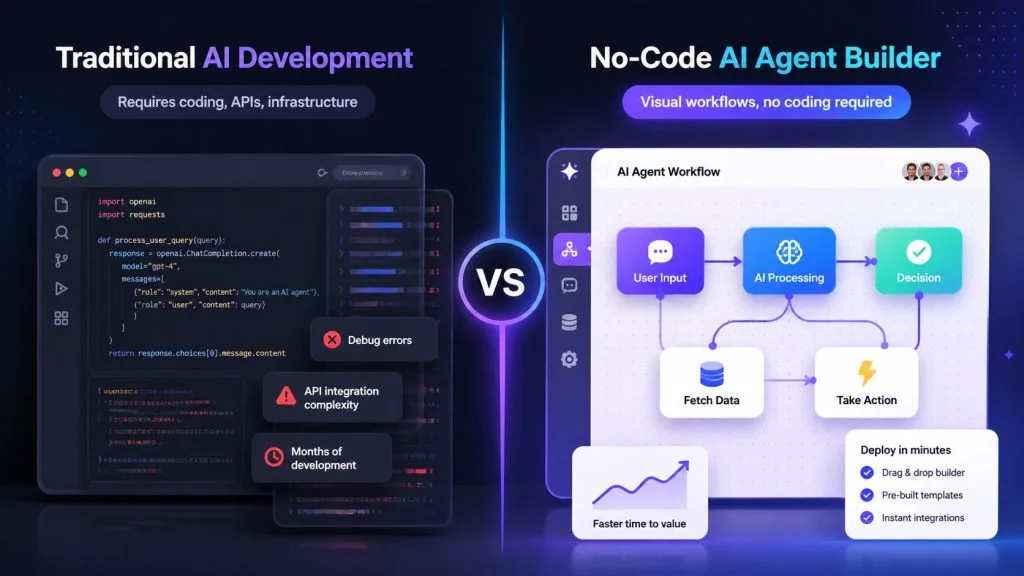
You don't need to code, raise massive funding, or invent new technology to start an AI business in 2026. The fastest path involves using existing AI tools to deliver services. Most successful AI companies wrap existing models like ChatGPT or Claude, winning on workflow, data, and distribution rather than training their own foundational models (forbes.com).
Service-based models, such as AI automation agencies, content creation studios, chatbot concierge services, and prompt engineering consulting, are accessible opportunities. Many AI side hustles can begin for under $100, often needing only one AI tool subscription (around $20/month) and a free freelance marketplace account (forbes.com). The crucial skills are clear instructions (prompt engineering), good business judgment, and consistency. For example, GoDaddy Airo AI Builder allows users to describe an idea and build simple apps or sites in minutes.
Feeling overwhelmed by the sheer number of tools and the complexity of building and selling AI-powered solutions? Imagine having an all-in-one cloud desktop where AI agents help you create, deploy, manage, and resell digital products. This is where TashiOS comes in. It's an AI-powered cloud desktop that runs on your private VPS, bundling the OS, the VPS itself, and monthly AI credits into one flat subscription. It streamlines the entire process, making it easier for freelancers and entrepreneurs to build client-ready digital products without juggling many separate tools.
5. AI as Core Infrastructure: Building Integrated Solutions
AI is no longer an isolated tool; it's becoming a foundational layer embedded across enterprise platforms, workflows, and decision systems. This shift means thinking about AI as an integral part of your business infrastructure.
Worldwide spending on AI is expected to exceed USD 2.02 trillion in 2026, representing a 36% annual increase (articsledge.com). The differentiator is moving from mere AI adoption to AI maturity and execution discipline. This means focusing on running AI safely, predictably, and at scale. The best AI tools for enterprises in 2026 are not individual chatbots but layered stacks.
These stacks include a horizontal context layer like Glean, one or two general reasoning tools such as ChatGPT Enterprise or Claude Enterprise, suite-native copilots like Microsoft Copilot or Google Gemini Enterprise, and domain-specific AI agents. Major players like Google Gemini, Microsoft Copilot, Salesforce Einstein, HubSpot AI, and Zendesk AI are deeply integrating AI into their core platforms to enhance productivity, customer service, and CRM automation. Jasper AI, for instance, has evolved into a full content operations platform, helping marketing teams cut production time by 60%.
6. Cutting-Edge AI Models: Powering Your Ventures in November 2026
November 2026 has seen significant advancements in AI models, making them more powerful, specialized, and cost-effective. Staying updated on these breakthroughs is key for any AI entrepreneur.
Autonomous agents that plan and complete multi-step workflows are a major recent advancement, as discussed with Agentic AI. We're also seeing impressive strides in AI video generation; ByteDance's Omnihuman 2.0 can create up to five minutes of continuous high-definition video from a single image and audio track. Google released Gemini Omni 1.2 Flash for longer AI video in early November 2026 (ibtimes.com).
Smaller open models like Llama 3.1 and Mistral Large 2 are approaching the performance of large closed systems at a much lower computing cost. Mistral opened a public preview of Mistral Large 4, a multimodal model with a 1M-token context window, in October 2026. Claude Haiku 5.5, released in October 2026, costs just $0.10 per million input tokens for prompts up to 100K tokens, about 75% less than Haiku 4.5 (ibtimes.com). In November 2026, OpenAI also began rolling out GPT-6 Cyber to vetted security teams and made GPT-6 Sol and Luna available to ChatGPT users. Data scarcity is also pushing labs towards synthetic data, simulations, and IoT device data for training.
7. Responsible AI: Ethics and Sustainability for Long-Term Success
As AI becomes more pervasive, responsible implementation, security, and environmental impact are increasingly vital considerations for any AI business. Focusing on these aspects will build trust and ensure long-term viability.
By 2026, the focus has shifted from rapid adoption to responsible implementation. Companies must treat AI agents like new employees, requiring clear boundaries, performance metrics, constant oversight, and audit protocols. Gartner predicts that by the end of 2026, 'death by AI' legal claims will exceed 2,000 due to insufficient AI risk guardrails (secondtalent.com). Explainability, ethical design, and clean data are becoming non-negotiable.
Data privacy and intellectual property are also critical. With about 50% of online content potentially AI-generated, permissioned, human-generated customer data is becoming a valuable asset. Founders must carefully check IP and privacy before publishing AI-generated content, music, or AI voices, as they carry license and consent risks. Furthermore, the increasing energy demands of AI are raising concerns about sustainability. AI workloads are expected to require 200% of 2022 data center power usage by 2027, making energy-efficient AI models a strategic priority for 2026.
Why TashiOS for Your AI Business in November 2026?
Navigating the complexities of launching an AI business, especially with the rapid changes in technology and ethical considerations, can be daunting. TashiOS simplifies this journey by providing a unified environment for your AI ventures.
Instead of stitching together various AI chat tools, code editors, hosting, and client management systems, TashiOS offers an AI-powered cloud desktop that combines all of these into one workspace. Its built-in AI assistant, Skynet, allows you to describe an app or website in plain English, and it builds it for you, no coding required. This makes sophisticated AI development accessible even if you don't have deep technical skills, aligning perfectly with the 'low-code/no-code' trend for starting your own AI business.
With TashiOS, everything you build – your apps, code, and customer data – belongs to you and lives on your own private server. This gives you full data control and eliminates vendor lock-in, a crucial aspect in an era of increasing data privacy concerns. Plus, for a flat $49/month, you get your private VPS, the cloud desktop, over 25 built-in apps, and $150 in AI credits ($100 starter budget + $50 bonus). This predictable cost structure stands in stark contrast to the often unpredictable per-API-call billing of many cloud AI APIs.
The AI business landscape in November 2026 is ripe with opportunity, but it demands a strategic approach. Focusing on specialized solutions, embracing agentic AI, and prioritizing responsible implementation will set you up for success. With tools like TashiOS, you have the power to create, sell, and manage AI-powered digital products more efficiently than ever before.
Ready to turn your AI business ideas into reality? Explore how TashiOS can be your all-in-one solution for building a recurring-income business with AI. Start your 7-day free trial today, with $0 charged upfront. Visit TashiOS pricing to learn more and begin your AI entrepreneurship journey.