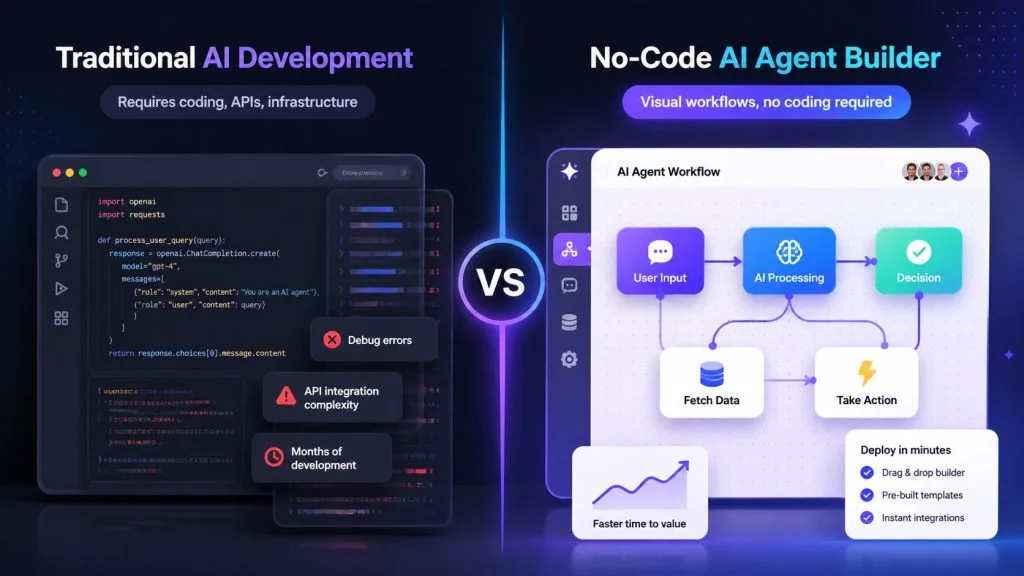
Did you know that by November 2026, a staggering 63% of AI app builder users have no coding background? This isn't just a trend, it's a complete shift in how we create technology. The no-code AI app building market is exploding, empowering everyone from seasoned entrepreneurs to everyday citizen developers to bring their ideas to life.
What does this mean for you? It means the power of artificial intelligence is more accessible than ever before. Forget complex programming languages or expensive development teams. Today, you can build sophisticated AI-powered applications with visual tools and plain English descriptions.
The Exploding World of No-Code AI in November 2026
The no-code AI platform market is undergoing explosive growth. Valued at approximately USD 6.56 billion in 2025, it's projected to reach USD 8.6 billion in 2026, according to Fortune Business Insights. Some estimates even suggest it could hit USD 75.14 billion by 2034, growing at a Compound Annual Growth Rate (CAGR) of 31.13% during this period, as reported by Mordor Intelligence.
This rapid expansion is fueled by a strong demand for faster application development, the automation of workflows, and the democratization of AI tools. The lines between traditional developers and non-developers are blurring, with citizen developers now outnumbering professional developers by roughly 4:1. Gartner's prediction that by 2025, 70% of new applications would use low-code or no-code technologies appears to be a reality in 2026.
Key Developments Shaping the Market:
- Agentic AI: The no-code AI area in 2026 is increasingly defined by "agentic AI." These systems can think, plan, and act independently. They automate complex, multi-step business workflows, process messy documents, and make autonomous decisions without backend code.
- AI-Assisted Development: Platforms now integrate AI to help design workflows, generate logic, and automate parts of the application development process. Tools like Zite let users describe workflows in plain language, and the AI generates the core app, including pages, forms, and database tables.
- Enhanced Governance and Security: As more teams build applications, there's a growing need for stronger governance features, clearer policies, monitoring tools, and access controls. Enterprise-grade platforms like StackAI offer audit logs, human oversight, and support for compliance requirements like SOC 2 and GDPR.
- Multimodal Generative AI: Emerging multimodal generative AI allows systems to process multiple data types simultaneously for more organic user interactions. This technology is expected to climb at a 44.26% CAGR to 2031.
- Cloud-Based Dominance: Cloud-based no-code AI platforms hold 62% of the market share, driven by their scalability, flexibility, and cost-efficiency.
Recent News and Announcements (2025-2026):
- Google announced it is switching off Opal, its Labs no-code builder for AI mini-apps launched in July 2025, on November 17, 2026. This shows the dynamic nature of the market.
- In May 2026, Asana acquired Stack AI, a no-code platform for building enterprise agents and workflows.
- Bubble launched a native mobile app builder based on React Native in June 2025. This lets users publish directly to the App Store and Google Play.
- OpenAI's GPTs and Assistants API has evolved into a full GUI-based no-code platform for creating robust AI applications using natural language instructions.
- Microsoft discontinued its per-app plan for Power Apps in January 2026, focusing on per-user and enterprise plans with AI-assisted development via Copilot.
Agentic AI: The Brains Behind the No-Code Revolution
The rise of agentic AI is arguably the most significant development in no-code AI app building. These aren't just simple automations. Agentic AI systems are capable of independent thought, planning, and action. They can automate complex, multi-step business workflows, process messy documents, extract semantic context using Large Language Models (LLMs), and make autonomous decisions.
Experts emphasize that the durable trend is not "AI replaces no-code," but rather "AI makes governed no-code faster." While usage of AI coding tools is at an all-time high, interestingly, trust in their output is at an all-time low. Only about 33% of developers trusted AI code accuracy in 2025, down from 43% in 2024. This highlights the need for no-code solutions that empower non-developers to build, while still allowing for human oversight and governance.
Platforms like TashiOS, a self-hosted AI OS for your VPS, are at the forefront of this shift. TashiOS combines all the tools you need into one cloud workspace, powered by AI agents that help you build, deploy, manage, and resell digital products. This integrated approach solves the problem of stitching together many separate tools, offering a unified environment for creating client-ready digital products.
Why TashiOS is Your AI-Powered Launchpad in November 2026
Creating and selling digital services usually means juggling many separate tools: AI chat, code editors, hosting, website builders, automation tools, email platforms, and client management. This fragmented approach can be costly and inefficient. TashiOS solves this problem by providing an AI-powered cloud desktop that runs on your own private VPS, bundling everything you need into one coherent system.
Here's how TashiOS empowers you in the current no-code AI landscape:
- AI Builds, You Earn: TashiOS features Skynet, its built-in AI assistant. You simply describe an app or website in plain English, and Skynet builds it. No coding is required, making advanced AI app building accessible to everyone.
- Full Ownership and Control: Unlike many cloud AI APIs or platforms, everything you build with TashiOS, including your apps, code, and customer data, belongs entirely to you. It lives on your own private server, giving you full data control and freedom from vendor lock-in.
- Predictable Costs: TashiOS offers a flat $49/month subscription. This includes your private VPS, the cloud desktop, over 25 built-in apps, and $150 in AI credits ($100 starter budget + $50 bonus). This predictable cost model eliminates the per-API-call billing common with cloud AI services, giving you peace of mind.
Ready to experience the future of digital product creation and sales? Take control of your AI journey and explore what you can build with TashiOS. Visit tashios.com to learn more.
Practical Implications and Future Predictions
The rise of no-code AI app building has several practical implications for businesses and individuals:
- Democratization of AI: AI is now accessible to business users, analysts, and operations teams who lack technical expertise.
- Faster Innovation: Organizations can prototype faster, reduce development timelines, and respond more quickly to market needs. Most no-code apps go from idea to first user in 3 to 14 days, compared with 6 to 12 months for traditional coding.
- Cost Reduction: By eliminating the need for extensive programming and specialized developers, no-code AI significantly reduces development costs. Paid plans are often between $19-$69 per month, a fraction of the $20,000-$200,000+ for custom app development.
- Focus on Business Logic: Users can concentrate on defining their business workflows and desired outcomes, rather than getting bogged down in coding complexities.
Predictions for 2027 and Beyond:
- Deeper AI Integration: No-code tools will expand built-in AI features like predictive analysis and natural language processing within their development environments.
- Growth of Citizen Development: More employees outside traditional IT teams will continue to build internal tools using visual development platforms.
- Agentic AI Dominance: The shift towards agentic AI, where systems can think, plan, and act independently, will continue to define the no-code area.
- Focus on Value over Adoption: In 2027, organizations will be expected to show measurable value from AI, moving from "tokenmaxxing" (usage) to "valuemaxxing" (impact).
TashiOS helps address these future needs by providing a governed, self-hosted environment where you maintain full ownership of your data and creations. Its comprehensive suite of tools ensures you are ready for the increasing demands of AI-driven business.
Step-by-Step: Building Your No-Code AI App in November 2026
Building an AI-powered application without code in November 2026 is more accessible and powerful than ever. Here's a practical, step-by-step guide to get you started:
Step 1: Define Your App Idea and Target User
Before diving into tools, clearly articulate what your app will do and for whom. A clear vision makes the building process much smoother.
- Example: "An internal tool for the HR department to automatically categorize incoming employee requests (e.g., vacation, payroll, IT support) and route them to the correct team member, reducing manual sorting time."
Step 2: Choose the Right No-Code AI Platform
Your choice of platform depends on your specific needs, complexity, and desired output (web app, mobile app, automation workflow, AI agent).
- For complex web apps/SaaS: Consider Bubble.
- For data-first applications and enterprise workflows: Look at Airtable.
- For native mobile apps: Adalo or FlutterFlow are strong contenders.
- For AI-driven app creation from natural language: Platforms like Zite or BuildAI are excellent starting points.
- For advanced AI automation and agent workflows: Explore n8n, Make, or Zapier.
- For enterprise-grade AI orchestration with governance: StackAI is a good option.
Step 3: Describe Your Workflow (AI-Assisted Generation)
Many modern no-code AI platforms allow you to start by simply describing your app's functionality in plain language. This is where AI truly accelerates development.
- Action: Log in to your chosen platform (e.g., Zite, Airtable Omni, BuildAI). Use a prompt like: "Create an app that takes employee requests via a form, uses AI to classify the request type (e.g., 'HR', 'IT', 'Payroll'), and then assigns it to the appropriate department lead."
- Outcome: The AI will generate the core structure, including initial pages, forms, and database tables.
Step 4: Set Up Your Database and Data Structure
Every app needs to store and manage data. This step involves organizing how your app will handle information.
- Action: Configure your database. If using a platform with a built-in database (like Zite or Bubble), define your tables (e.g., "Requests," "Employees," "Departments") and fields (e.g., "Request ID," "Employee Name," "Request Type," "Description," "Assigned To," "Status").
- Integration: If your data is in external sources like Google Sheets or Airtable, connect them directly.
Step 5: Integrate AI for Processing and Logic
This is where the "AI" in no-code AI comes to life, automating intelligent decisions within your application.
- Action: Connect the platform's built-in AI or integrate an external LLM (e.g., OpenAI API key).
- Workflow: Design the AI workflow: When a new request form is submitted, trigger an AI action. Use the AI to analyze the "Description" field and classify the "Request Type" (e.g., using a pre-trained model or a prompt). Based on the classified "Request Type," use conditional logic to assign the request to the correct department lead.
- Tools: Platforms like Make or n8n excel at building these complex, multi-step AI automation workflows. With a platform like TashiOS, its built-in Skynet AI assistant can handle much of this initial setup from your plain English descriptions, making the process even faster.
Step 6: Build Your User Interface (UI) and Workflows
Visually design how users will interact with your app. This involves creating the forms, dashboards, and views that make your app functional.
- Action: Use drag-and-drop components to create forms for submitting requests, dashboards for viewing requests, and detailed views for individual requests.
- Logic: Define workflows for actions like "Submit Request," "Update Status," or "View Assigned Requests." Set up user authentication and role-based permissions (e.g., employees can submit, department leads can view and update).
Step 7: Test and Refine
Iterative testing is crucial for a functional and user-friendly app. This step helps you catch errors and improve usability.
- Action: Test the app with real users (e.g., HR employees). Submit various requests and verify that the AI correctly classifies and routes them. Gather feedback on usability and functionality.
- Refinement: Use the platform's visual editor or AI-assisted chat to make adjustments to the design, logic, or data structure based on feedback.
Step 8: Launch and Deploy
Once satisfied, deploy your application to make it available to your users.
- Action: Publish your app. This might involve generating a web link, deploying to a custom domain, or submitting to app stores (for native mobile apps).
- Monitoring: Implement monitoring to track app performance, AI accuracy, and user engagement.
The future of app development is here, and it's no-code, AI-powered, and incredibly accessible. Don't get left behind. Start building your recurring income business today with TashiOS and experience the power of 'AI builds. You earn.' Visit tashios.com/pricing to begin your 7-day free trial.