Imagine building a complex AI application just by describing it in plain English. In November 2026, this isn't science fiction; it's the new reality of no-code AI app building. The global no-code AI platform market, valued at a staggering USD 8.6 billion in 2026, is on track to hit USD 75.14 billion by 2034, showing a remarkable 31.13% Compound Annual Growth Rate (CAGR) (Fortune Business Insights, Mordor Intelligence). This explosive growth isn't just about faster development; it's about a fundamental shift in how we create software, putting powerful AI tools directly into the hands of millions.
The Explosive Growth of No-Code AI App Building in November 2026
The period between 2025 and 2026 has marked a pivotal shift in the no-code AI app building area. We've seen a strong emphasis on integrating AI capabilities directly into platforms and enabling natural language-based development. This isn't just incremental progress; it's a full-scale transformation.
Market data tells a compelling story. While some estimates place the no-code AI platform market at USD 4.88 billion in 2026, growing to USD 12.25 billion by 2031 at a 20.19% CAGR, others like Grand View Research project it at USD 8.4 billion in 2026, reaching USD 52.1 billion by 2033 with a 29.8% CAGR. Fortune Business Insights and Mordor Intelligence peg the market at USD 8.6 billion in 2026, soaring to USD 75.14 billion by 2034 with a 31.13% CAGR. The broader no-code automation market stands at USD 13.8 billion in 2026, showcasing the immense economic activity in this space (Fortune Business Insights, Mordor Intelligence, Grand View Research).
This growth is fueled by an "AI-Powered Citizen Developer Revolution." Experts agree that AI isn't replacing no-code; instead, AI makes governed no-code faster, allowing businesses to build compliant applications at scale. Citizen developers now significantly outnumber career programmers, by roughly four to one. We're talking about 100 to 120 million business users globally who are now building software on these platforms (Floot). This widespread adoption is a testament to the accessibility and power of these new tools.
The return on investment (ROI) for no-code adopters is impressive, with companies reporting an average 362% ROI. A remarkable 91.9% of projects recover their initial investment within the first twelve months. Development timelines can compress by as much as 90%, and typical application costs drop 70% to 74% (Caspio). These figures highlight the undeniable business advantages of embracing no-code AI.
From Drag-and-Drop to "Vibe Coding": Natural Language Takes Over
A significant development in 2026 is the shift from traditional drag-and-drop interfaces to "natural language building," often called "vibe coding." Users can now describe their desired app or workflow in plain English, and AI generates the architecture, database schema, and frontend components. This intuitive approach drastically lowers the barrier to entry for app creation.
Adalo's AI Builder, released in early 2026, exemplifies this prompt-based app creation and editing. Similarly, Kissflow made its AI Builder, a conversational app builder, generally available in May 2026. These tools let users simply chat with an AI to bring their application ideas to life, making the process feel more like a conversation than a coding session.
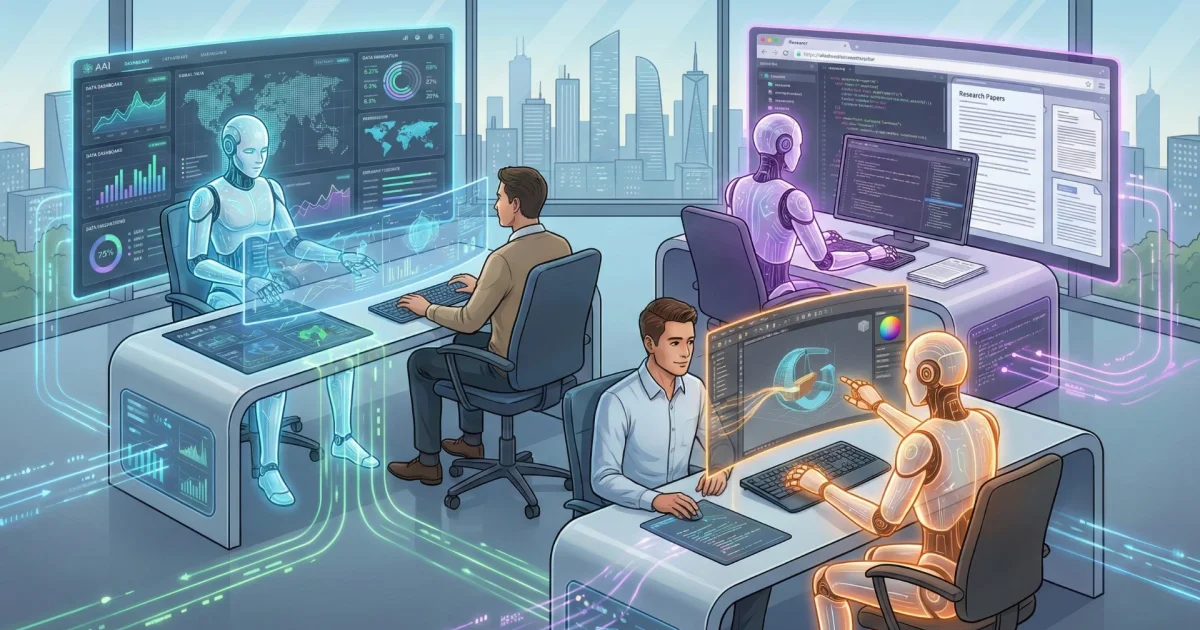
Beyond app building, the rise of AI agents is a core component of this evolution. These agents enable autonomous, multi-step workflows across various tools. By 2026, internal teams routinely rely on AI agents for operations, support triage, reporting, and coordination. Platforms like n8n now enable real AI agent workflows using OpenAI and Anthropic nodes without coding, allowing businesses to automate complex processes with ease.
Frontier AI developments in November 2026 further underscore this trend. Anthropic released Claude Fable 5.2, which is up to 30% faster and 20% cheaper. Meta launched Muse Ember, a tiny "worker" model designed specifically for AI agents. Google's Gemini 4 Carbon was released for security teams, and CrowdStrike introduced an "AI Kill Switch" to stop agents that go off script. OpenAI's Dots are also emerging as always-on AI agents working in the background on their own cloud computers. These advancements mean more sophisticated, reliable, and specialized AI agents are becoming available for no-code platforms.
Industry Leaders and Emerging Innovators Shaping the No-Code AI Area
The no-code AI app building area is vibrant with established players and innovative newcomers. Each offers unique strengths, pushing the boundaries of what citizen developers can achieve.
Microsoft Power Platform continues to integrate AI Builder and Copilot Studio, empowering users to build robust business apps and automate workflows. Their commitment to embedding AI across their ecosystem makes them a dominant force. Google AppSheet offers Gemini-assisted builds and Optical Character Recognition (OCR), with Google Cloud also introducing additional Gemini-powered no-code AI in May 2026. This deep integration with advanced AI models makes app creation smarter and more efficient.
Bubble now incorporates AI for app generation, with changes visible and editable directly within its visual editor. This blend of AI generation and visual control gives users the best of both worlds. For workflow automation, Zapier, Make (formerly Integromat), and n8n remain leading platforms. n8n, in particular, stands out for enabling real AI agent workflows using OpenAI and Anthropic nodes without coding, making complex automations accessible.
Specialized platforms are also making significant strides. Voiceflow specializes in building conversational AI agents like chatbots and voice assistants using visual flow editors. StackAI, a dedicated no-code AI orchestration platform for enterprise-scale operations, especially in regulated sectors, was acquired by Asana in May 2026. This acquisition highlights the growing importance of enterprise controls, audit logs, and certifications like SOC 2 Type II and ISO 27001 in this market.
Salesforce offers Agentforce Builder and App Builder for creating AI agents and applications directly on Salesforce customer data. In November 2026, Esri introduced the Data Explorer, providing a no-code way to create agentic mapping apps that interact with geospatial data through natural language. Other notable platforms include Lindy, Gumloop, Replit, Glean, Writer AI, Airia, Vellum AI, Airtable (with its conversational AI builder Omni launched in 2025), FlutterFlow, Softr, Knack, Base44, QuickBase, Lovable, Zite, Glide, OutSystems, Mendix, Appian, AWS App Studio, ServiceNow App Engine, Retool, and Creatio. The sheer number and diversity of these platforms underscore the rapid innovation in the no-code AI app building space.
Tangible Benefits and Real-World AI Impact
The widespread adoption of no-code AI tools isn't just a trend; it's driven by tangible benefits that businesses are realizing every day. These tools offer faster time to value, significantly reduced dependence on engineering resources, and lower development costs. They improve workflow automation, ensure better integration between business systems, increase operational efficiency, and provide greater accessibility for non-technical teams.
AI applications built with no-code are transforming various business functions. In customer support, AI chatbots now handle FAQs, order status inquiries, and ticket triaging, escalating complex issues to human agents only when necessary. For sales and marketing, AI assists with lead qualification, personalized outreach, content generation, and campaign automation, freeing up human teams for strategic tasks. Finance and HR departments are using no-code AI to automate invoice processing, payment approvals, candidate screening, and onboarding tasks, streamlining operations significantly. In operations and business intelligence, these tools generate weekly performance summaries, perform inventory and demand forecasting, and enhance knowledge management. Document processing also sees huge gains, as AI extracts key fields from invoices, contracts, and forms, sending structured data into systems automatically.
Real-world examples illustrate this impact vividly. A support team, for instance, uses an AI chatbot to answer common questions, handling 40-60% of incoming support volume. The city government of Kobe utilized no-code AI tools to process applications in hours instead of days, significantly reducing manual data entry and error rates. PwC implemented low-code AI bots connected to Microsoft Cognitive Search and internal knowledge bases, allowing staff to retrieve answers in seconds rather than hours. Microsoft Power Apps was used to build a camera-first experience for merchandising compliance, reducing manual input and providing near real-time data. These examples show how no-code AI app building is creating measurable improvements across diverse organizations.
Why TashiOS for Your No-Code AI App Building Journey
As the no-code AI app building market expands, choosing the right platform becomes crucial. Many tools excel at one specific task, but the real power comes from an integrated environment. This is where platforms like TashiOS, an AI cloud desktop for creating, selling, and managing websites, apps, and automations, really shine.
TashiOS directly addresses the "vibe coding" trend with Skynet, its built-in AI assistant. You describe an app or website in plain English, and Skynet builds it, completely eliminating the need for coding. This mirrors the natural language building capabilities seen in leading platforms, but within a unified workspace. Furthermore, TashiOS runs on your own private VPS, ensuring full data control and solving the critical "trust problem" that many cloud-based AI solutions face. You own everything you build, from apps and code to customer data, without vendor lock-in.
Instead of juggling separate AI chat, code editors, hosting, website builders, and automation tools, TashiOS combines all of these into one cloud workspace. It ships with over 25 built-in apps and tools designed for building, automating, and running an online business. This comprehensive approach means you can create, sell, and manage digital products from one place, making it ideal for freelancers, entrepreneurs, and agencies. Plus, TashiOS offers a predictable flat monthly cost of $49, which includes your private VPS, the cloud desktop, all apps, and $150 in AI credits. This contrasts sharply with the unpredictable, per-API-call billing of many cloud AI APIs.
Navigating the Future: Governance, Trust, and Agent-First Workflows
The future of no-code AI app building points towards even greater accessibility, intelligence, and a significant shift in how applications are conceived and managed. One of the clearest predictions is the move towards agent-first workflows. AI agents are expected to replace traditional interfaces before they replace entire applications. By 2026, applications are becoming infrastructure, interfaces are fading into the background, and decisions, not screens, are becoming the primary touchpoint. Internal teams are already routinely relying on AI agents for operations, support triage, reporting, and coordination.
This evolving area also means a thinning boundary between "builder" and "developer." A non-technical founder can now describe an app in plain text and have a deployable React application running in under an hour. The founder's role is shifting from builder to editor, focusing on refinement and strategic oversight rather than initial construction. This new paradigm emphasizes speed and iteration.
However, with increased automation comes a critical emphasis on governance and trust. While AI-generated speed is a major advantage, low-code platforms are gaining ground because they address a "trust problem" more than just a "speed problem." The ability to explain, review, and hand over a visual, bounded system is crucial, especially for mission-critical applications. Governance, security, and compliance, including certifications like SOC 2 Type II, HIPAA, and GDPR, are paramount, particularly in regulated industries. The EU AI Act training obligations, enforceable since August 3, 2026, also significantly impact organizations globally.
The market is moving towards more agents that do one thing well, rather than trying to be general-purpose. The "last 20%" of reliability and error handling without adding complexity is becoming a key selling point. Proprietary data is also becoming an assumed requirement for effective AI applications, highlighting the importance of data ownership and control, a core offering of platforms like TashiOS. Managing tool sprawl is another growing concern; the proliferation of no-code AI tools necessitates a strategic approach to avoid it becoming a competitive disadvantage. Standardizing on a tight stack of well-chosen tools is crucial for maximizing ROI and managing governance effectively. Expect deeper AI integration, stronger governance features, broader integrations, and AI-assisted development to shape the next phase of platform growth, always keeping a human-in-the-loop for exceptions and high-stakes decisions.
The no-code AI app building revolution is here, transforming how businesses operate and empowering a new generation of creators. With platforms that let AI build and you earn, the future of digital product creation is more accessible and powerful than ever. If you're ready to create, sell, and manage digital products without the complexity, explore what's possible.
Ready to build your next AI-powered app or website without writing a single line of code? Discover the all-in-one AI cloud desktop that puts you in control. Start your 7-day free trial today at tashios.com/pricing.