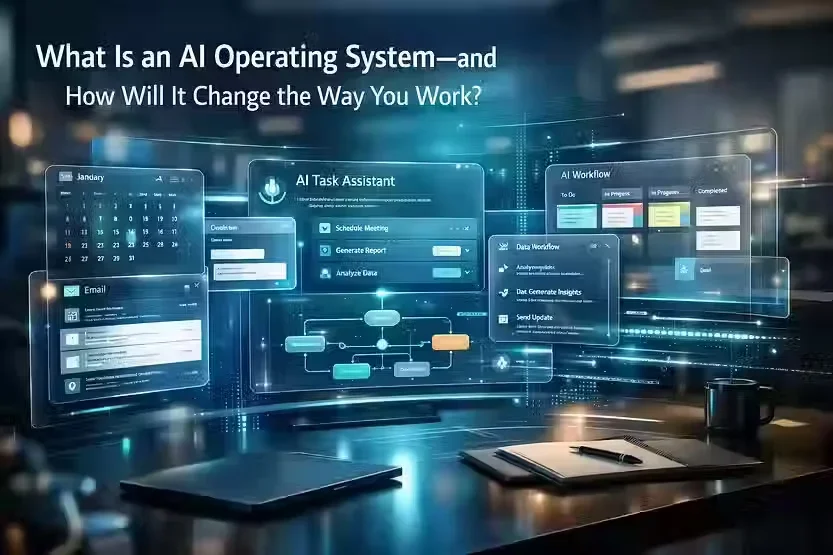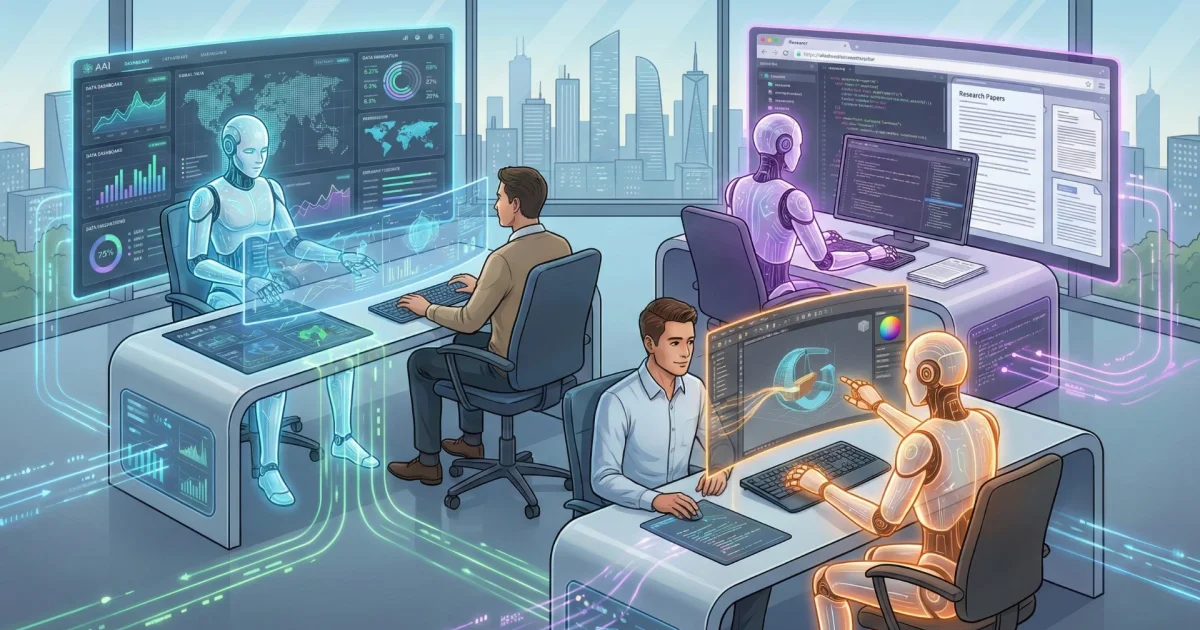
Imagine AI not just answering your questions, but actively *doing* your work. This isn't a future prediction; it's the reality of November 2026. The biggest AI story of this month, and indeed the year, is the seismic shift from conversational chatbots to autonomous AI agents. These intelligent systems don't just respond to prompts; they orchestrate tools, take initiative, and automate entire workflows, moving beyond isolated interactions to orchestrated productivity (mean.ceo).
This comprehensive overview explores the latest developments, practical implications, and the tools you need to thrive in this new agentic AI world. We'll look at the cutting-edge models, real-world applications, and the market forces driving this rapid evolution. Nearly 19% of the world's working-age population already uses generative AI, showing just how integrated these tools have become by Q2 2026.
The Agentic Revolution: AI That Works for You
The core of current AI trends is the move towards 'agentic AI.' This means AI systems are designed to perform complex, multi-step tasks without constant human intervention. They can plan, execute, monitor, and even correct their own actions. Experts agree this is the biggest AI story of 2026: handing software real work, not just asking it questions (mean.ceo).
This evolution is supported by massive investments, rapid model development, and a growing emphasis on practical enterprise applications. The global corporate AI investment has surpassed $1 trillion in 2026, a 46% increase over the entire 2025 total. Goldman Sachs projects $1 trillion in AI-related investment globally this year, with $581 billion in the US alone (risingtrends.co).
November 2026 Model Releases: The New AI Powerhouses
Major players are pushing the boundaries with new models designed for agentic capabilities:
- OpenAI's Advancements: OpenAI introduced GPT-6 Cyber on November 5, a specialized model for cybersecurity tasks. It significantly improved ExploitGym scores to 48.5%. They also launched ChatGPT Images 2.6 on November 4, boosting image generation speed by 50% and adding animated GIF creation. API variants like GPT-Image-2.6 Flare (for speed) and Sunburst (for detail) offer tailored options. Furthermore, GPT-6.1 Terra (for visual reasoning) and GPT-6.2 Astra (high on Artificial Analysis's Intelligence Index v5) are now available in their API.
- Google's Gemini Expansion: Google made Gemini 4 Carbon generally available on November 10. This model excels at complex coding, debugging, and scientific research, capable of inspecting code, making changes, running tests, and correcting errors autonomously. Gemini 4 Hydrogen became the default in Google Search AI Mode on November 12, serving as a fast everyday model. Google also released Gemini Decision 1 for quick yes/no decisions and made Gemini Omni 1.2 Flash generally available on November 5, extending native video generation to 15 seconds and reducing 720p generation price by 30% to $0.07 per second.
- Anthropic's Breakthroughs: Anthropic released Claude Fable 5.2 on November 9, which leads Artificial Analysis's Intelligence Index v5 at 64.6 and took first place on Arena's WebDev board for coding. They also limited access to Claude Mythos 5.2 to verified organizations in cybersecurity and life sciences.
AI in Action: Real-World Agentic Applications
The impact of agentic AI is already visible across industries:
- Autonomous Debugging: Google's Gemini 4 Carbon is a prime example. It doesn't just suggest solutions; it actively inspects code, makes changes, runs tests, and debugs until a task is complete (mean.ceo). This moves AI beyond simple suggestions to active problem-solving.
- AI Security: CrowdStrike introduced an AI Kill Switch on November 3 as part of its Falcon Guardian product. This allows administrators to terminate rogue AI agents in real-time and block them from running again, addressing critical security concerns in autonomous AI operations (riskinfo.ai).
- Enterprise Integration: Adobe's CX Enterprise Coworker, a marketing agent, is now accessible within platforms like ChatGPT, Claude, Gemini for business, and Microsoft Copilot. This shows the increasing interoperability and embedded nature of modern AI agents.
- Industry-Specific Agents: IBM and Microsoft jointly announced Imagine Enterprise on November 10. This agentic platform helps enterprises build, run, and govern AI agents for industry-specific processes, especially in regulated sectors. IBM Consulting contributes over 6,000 pre-built AI agents and assets to this platform.
- Healthcare Transformation: AI is revolutionizing healthcare, assisting research ethics committees by reducing approval times for study proposals from weeks to days, all while maintaining review quality (aviusai.com).
Market Momentum: Trillions in Investment, Widespread Adoption
The AI market is booming. The global Artificial Intelligence market was valued at $143.0 billion in 2025 and is estimated to reach $184.7 billion in 2026 (risingtrends.co). Another report estimates the market size at $390.9 billion in 2025, growing to $539.5 billion in 2026, and projected to reach $3,497.3 billion by 2033 (elitegrowthmarketing.com).
Investment is surging, with the five largest US hyperscalers (Alphabet, Amazon, Meta, Microsoft, and Oracle) estimated to spend $800 billion or more on AI infrastructure in 2026, a 94% increase over 2025 (risingtrends.co). Adoption rates are also high: 88% of organizations worldwide reported using AI in at least one business function in 2025. By Q2 2026, nearly 19% of the world's working-age population was using generative AI (tuya.ai).
The agentic AI market specifically is projected for significant expansion, from $5.25 billion in 2024 to $199.05 billion by 2034, representing a 38-fold growth. Currently, 79% of organizations report some level of AI agent adoption, and 96% plan to expand their usage in 2026 (risingtrends.co). This growth translates to revenue, with 88% of survey respondents indicating AI has positively impacted their annual revenue, and 30% reporting a significant increase of over 10% (risingtrends.co).
Why TashiOS is Your Command Center for Agentic AI
As AI agents become central to business operations, you need a platform that helps you not just create, but also manage and profit from these powerful tools. This is where TashiOS shines. It's an AI-powered cloud desktop that runs on your own private VPS, bundling the OS, the server, and monthly AI credits into one flat subscription.
TashiOS solves the problem of stitching together countless tools for creating and selling digital services. Instead of juggling AI chat, code editors, hosting, website builders, and client management, TashiOS combines all of that into one cloud workspace. Its built-in AI assistant, Skynet, lets you describe an app or website in plain English, and it builds it for you, no coding required. This directly addresses the agentic AI trend by empowering you to create complex digital products with minimal effort.
A key differentiator for TashiOS is its focus on ownership and recurring income. Everything you build, from apps and code to customer data, belongs to you and lives on your own server. This gives you full data control and no vendor lock-in. Plus, TashiOS is designed for freelancers, entrepreneurs, and agencies to create, sell, and manage websites, apps, and automations as a recurring-income business. It's a complete ecosystem for generating revenue with AI.
Navigating the AI Tool Ecosystem: A November 2026 Review
The AI tool market in November 2026 is robust and diverse. Here's a look at some of the leading options across various categories:
General Purpose Conversational AI
- ChatGPT (OpenAI): Remains highly versatile with a comprehensive ecosystem of GPTs, plugins, and API access. It offers strong multimodal capabilities for text, image, and voice, serving as a mainstream reference for content creation, customer service, and coding.
- Gemini (Google): Provides a strong free tier and deep integration within the Google ecosystem (Gmail, Docs, Sheets, Calendar). Gemini 4 Argon, Google's flagship reasoning model, boasts a 1-million-token context window and native audio/video processing, making it powerful for data analysis and technical tasks.
- Claude (Anthropic): Excels in reasoning, handling long documents, and coding. Claude Fable 5.2 is a top-tier model for complex technical work, while Claude Opus 5.5 is a strong everyday option. Claude's interface prioritizes clarity for complex texts, suiting legal and project management professions.
Coding and Software Development
- Google Gemini 4 Carbon: A standout for complex coding, debugging, security analysis, and scientific research. Its autonomous code inspection and correction capabilities are especially impressive.
- Claude Fable 5.2: Leads Arena's WebDev board for coding, demonstrating its strong performance in software development tasks.
- Cursor: An AI-assisted coding tool that helps with multi-file architectural refactoring, making complex code changes more manageable.
Image Generation
- ChatGPT Images 2.6 (OpenAI): Currently the best AI for image generation, available on all ChatGPT plans, including free. It offers faster generation, animated GIFs, and saved reference images, leading multiple image generation benchmarks.
- Midjourney: A leading paid platform known for generating high-quality AI images with artistic flair.
- Stable Diffusion: A popular free and open-source option, offering flexibility and control for image generation.
Video Generation
- Google Gemini Omni 1.2 Flash: Offers extended native video generation up to 15 seconds, multi-turn conversational editing, and reduced pricing, making it more accessible.
- Runway: One of the most advanced platforms for generating and editing high-quality video, pushing the boundaries of what's possible.
- Veo (Google): Continues to push realism and motion consistency in video generation, aiming for lifelike output.
- Synthesia: Ideal for polished training videos, onboarding content, and corporate communications, focusing on professional-grade output.
Enterprise Productivity and Automation
- Microsoft Copilot for Microsoft 365: A fully integrated AI assistant within the Microsoft 365 ecosystem. It generates documents, presentations, and assists with workflows. The 2026 Copilot Pages update enables real-time collaborative AI-generated documents.
- Gemini for Google Workspace: Google's equivalent, embedded directly into Gmail, Google Docs, Sheets, and Calendar for drafting, editing, and analysis.
- Adobe CX Enterprise Coworker: A marketing agent integrated across various AI platforms, streamlining creative workflows.
- Smartsheet ENGAGE 2026: Features agentic workflows, creation, data-quality agents, and security streaming, enhancing project management.
- IBM and Microsoft Imagine Enterprise: A new platform for building, running, and governing AI agents for industry-specific processes, especially valuable in regulated sectors.
Amidst these specialized tools, TashiOS stands out as a comprehensive solution for those looking to build and monetize digital products using AI agents. With its flat $49/month pricing, including a private VPS and $150 in AI credits, it offers predictable costs unlike per-API-call billing. It combines all the necessary tools for building, automating, and running an online business, all while ensuring your prompts and data stay on your own VPS.
Want to turn these AI trends into a profitable business? TashiOS provides the AI cloud desktop you need to create, sell, and manage websites, apps, and automations as a recurring-income business. With Skynet, you can build client-ready digital products without any coding, all within a single, powerful workspace. It's the ultimate platform for freelancers, entrepreneurs, and agencies who are ready to let AI build while they earn.
What's Next: Predictions and Practical Implications
The shift to agentic AI means businesses will increasingly use AI for end-to-end automation of complex tasks, leading to significant gains in efficiency and productivity. The emergence of faster, cheaper frontier models and specialized 'worker' models is making AI more accessible and cost-effective for a wider range of projects, enabling businesses to achieve more AI power for less money (risingtrends.co).
As AI agents gain more autonomy, the focus on robust governance, security, and human oversight will intensify. Tools like CrowdStrike's AI Kill Switch and initiatives like Microsoft's AI Transparency Initiative reflect this critical need to manage risks associated with autonomous AI. Hyper-personalization, driven by AI's ability to process vast amounts of data, will enable real-time tailored experiences and offers for customers.
Industries will see transformative impacts. In healthcare, AI-supported care is becoming the new baseline, with solutions demonstrating compelling data at scale for improved outcomes and risk management. Software development is fundamentally changing, moving from manual coding to multi-file architectural refactoring and autonomous debugging. While AI investment continues at an unprecedented pace, the long-term economic impact will depend on whether demand for AI keeps pace with the massive investments (risingtrends.co).
The future is here, and it's agentic. Are you ready to build with it?
Ready to put autonomous AI agents to work for your business? Explore how TashiOS can empower you to create, sell, and manage digital products with ease. Start your 7-day free trial today!