Did you know that by 2025, 70% of new applications developed by organizations were already using low-code or no-code technologies? By November 2026, this isn't just a prediction; it's the new standard. This rapid shift has reshaped how businesses approach software development, giving rise to a new era where artificial intelligence meets no-code platforms to create powerful, custom applications faster than ever before. This isn't just about simple automation anymore; it's about building sophisticated, AI-powered solutions that drive real business value.
Consider the journey of Global Solutions Inc., a mid-sized enterprise that, in late 2024, faced a familiar struggle. They had a mountain of IT requests and a critical shortage of skilled developers. Their traditional development cycles were slow, and the idea of integrating advanced AI capabilities felt like a distant, expensive dream. Fast forward to today, November 2026, and Global Solutions Inc. has completely transformed its operational agility and innovation capacity. Their secret? A strategic embrace of no-code AI app building.
The AI-Powered Citizen Developer Revolution in November 2026
The period between 2025 and 2026 marked a pivotal shift in no-code AI app building. It moved beyond simple task automation to sophisticated, AI-powered solutions that now handle complex workflows. Experts note a durable trend: AI isn't replacing no-code; instead, AI makes governed no-code faster. This means businesses can build real, compliant applications at scale, not just throwaway prototypes.
Global Solutions Inc. was a prime example of a company struggling with the developer gap. They needed custom tools for everything from internal project management to customer service. The concept of "citizen developers" became their lifeline. These are non-technical founders, business analysts, and marketers who can now build, train, and deploy machine learning models without writing a single line of code. This directly addresses the persistent shortage of skilled developers; in fact, 87% of IT leaders agree that no-code or low-code helps bridge this gap.
The market reflects this explosion. The global no-code AI platform market, valued at USD 6.56 billion in 2025, is projected to reach USD 8.6 billion in 2026. It's forecast to hit an astonishing USD 75.14 billion by 2034, showing a Compound Annual Growth Rate (CAGR) of 31.13% (Fortune Business Insights). This growth isn't just in market size; citizen developers now outnumber career programmers by roughly four to one, with 100 to 120 million business users globally building software on these platforms.
"Vibe Coding" and AI Agents: Building Apps with Natural Language
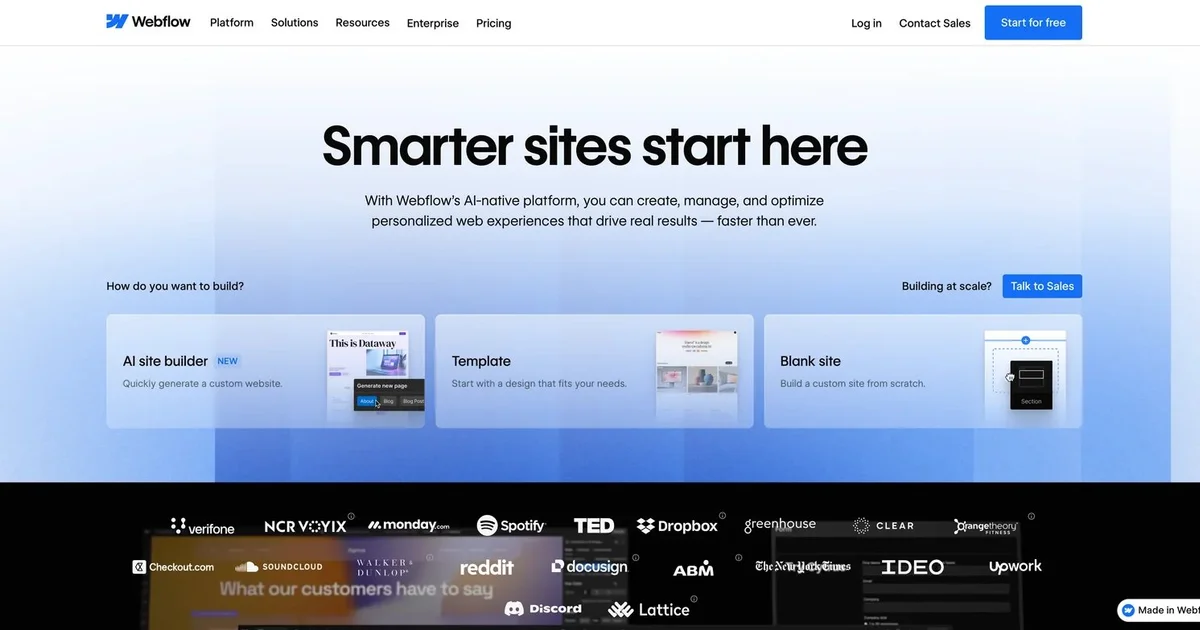
One of the biggest changes in 2026 is the shift from traditional drag-and-drop interfaces to "natural language building," often called "vibe coding." Users can now describe their desired app or workflow in plain English, and the AI generates the architecture, database schema, and frontend components. This was a game-changer for Global Solutions Inc., allowing their departmental leads to bypass IT bottlenecks entirely.
For instance, Adalo's AI Builder, released in early 2026, allows prompt-based app creation and editing. Users describe features in natural language, and the AI builds it. Over 3 million apps have been created on its platform. Similarly, Bubble now incorporates AI for app generation, with changes instantly visible and editable in a visual editor. Nativly AI stands out as a top AI app builder in 2026, offering end-to-end creation from idea to iOS and Android apps using plain-English prompts (nocodewebsitebuilder.com).
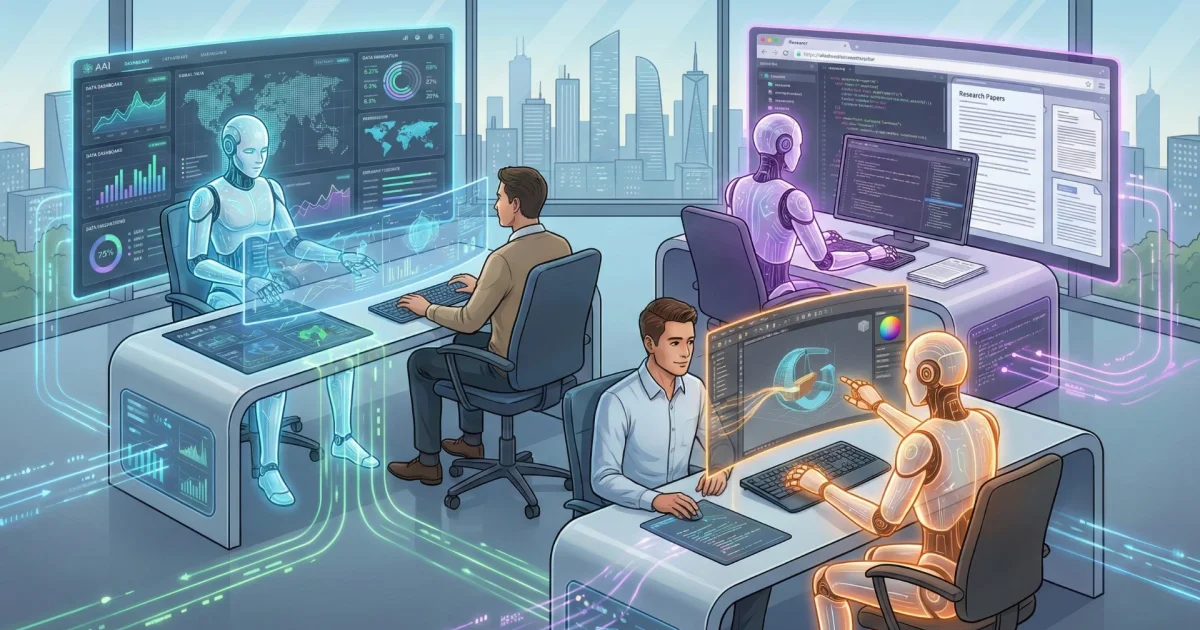
Another significant trend is the emergence of AI agents that can plan and complete multi-step tasks autonomously. Industry analysts project that 40% of enterprise applications will embed task-specific AI agents by the end of 2026, a substantial increase from less than 5% in 2025. Global Solutions Inc. quickly moved to implement these agents for their customer support and internal HR processes.
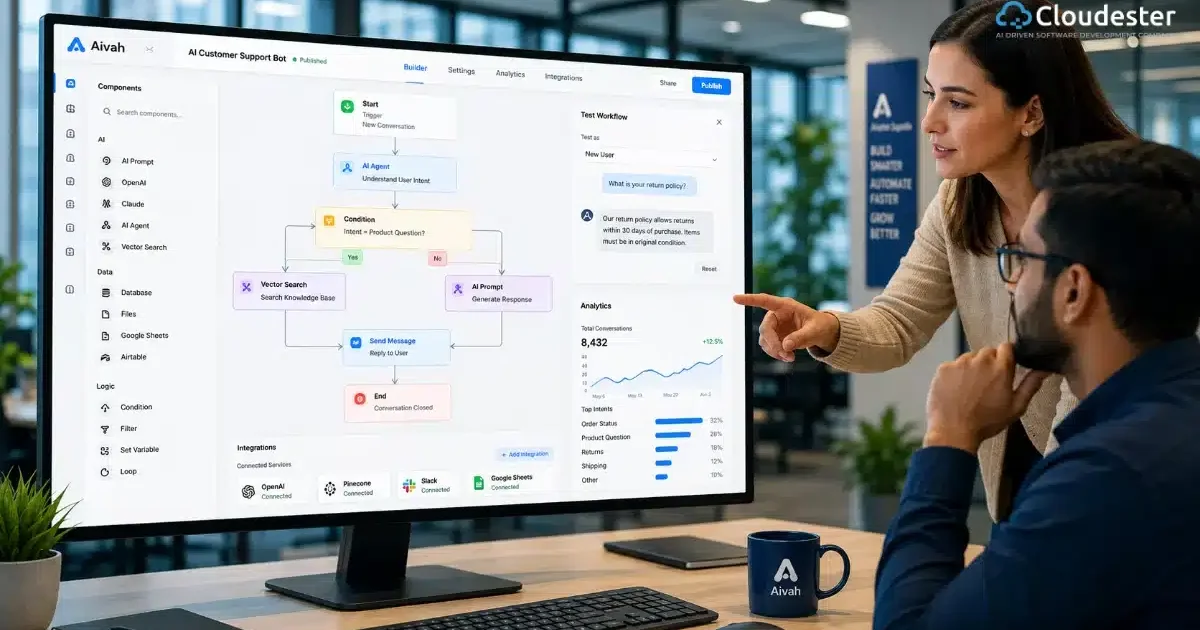
Platforms like Zammo.ai showcased "Zammo Agents" at the Smart City Expo World Congress in November 2026, enabling city staff to build AI agents in plain language for citizen services. Tools like n8n and Make (formerly Integromat) are leading in advanced multi-agent workflows, with n8n offering a "fair-code" approach where users own the code for their automations. Lindy and Relevance AI are also prominent in building trigger-based assistants and coordinating specialized agents across multiple stages.
Enterprise AI Integration and Native App Power
Major tech companies are embedding AI capabilities directly into their no-code offerings, making powerful AI accessible to more users. For Global Solutions Inc., this meant seamless integration with their existing enterprise systems. Microsoft's Power Platform, including AI Builder and Copilot Studio, allows users to create and use AI models within business tasks. Microsoft Build 2026 showcased how their Fabric and database tools work together for agentic applications. Google Cloud introduced additional Gemini-powered no-code AI features in May 2026, enhancing its Vertex AI platform for AutoML and generative AI tasks (ourcodeworld.com).
No-code platforms are also increasingly supporting native iOS and Android publishing. This was crucial for Global Solutions Inc., which needed customer-facing mobile apps without a full mobile development team. Bubble launched a native mobile app builder in June 2025, built on React Native, allowing direct publishing to app stores. FlutterFlow enables building once and shipping natively to iOS, Android, web, and desktop, complete with AI-assisted building features.
Real-World Impact: Speed, Savings, and Strategic Shifts
The democratization of AI through no-code platforms is creating tangible results for businesses worldwide. Global Solutions Inc. is just one story among many. Experts emphasize that these tools empower business users to build, train, and deploy machine learning models without writing code. This directly addresses the persistent shortage of skilled developers, with 87% of IT leaders stating that no-code or low-code helps bridge this gap.
Real-world success stories abound:
- Zapier's Internal Dashboard: Matt Brown, a growth marketing manager at Zapier, used no-code AI, specifically "vibe coding" with Claude and Zapier's own systems. He created a custom internal dashboard for tracking influencer partnerships. This involved generating data architecture, JavaScript, and HTML on the fly, with automatic bug fixing, providing instant insights for weekly team briefings (bakedwith.com).
- Leatherman's Company-Wide Adoption: The tool manufacturer Leatherman embraced no-code AI, encouraging staff across all departments, from manufacturing to HR, to "vibe code" solutions for daily problems. This initiative resulted in over 250 projects, including apps, dashboards, and automations, going into production across the company (buildez.ai).
- Booking.com's Developer Productivity: Online travel agent Booking.com deployed AI coding assistants across its 3,500-strong engineering team in early 2025. After initial training, developer productivity, measured by finished, reviewed work output, increased by 30% (datacamp.com).
- Asana's Acquisition of Stack AI: In a notable industry move in May 2026, Asana acquired Stack AI, a no-code platform known for enterprise deployment and governance. Stack AI provides audit logs, feature controls, and over 100 enterprise integrations. This highlights the growing importance of governed no-code AI solutions for regulated industries.
The implications are clear: faster time to value and reduced costs. Organizations can launch AI workflow automation in days or weeks instead of months, significantly cutting development costs and reducing dependency on scarce engineering resources. Companies have reported saving an estimated $4.4 million over three years by using no-code tools instead of hiring additional developers (caspio.com).
This shift also means the founder's role is evolving from a builder to an editor, focusing on discerning which problems matter and which systems will hold under real-world pressure, as execution becomes cheap and fast. Furthermore, proprietary data is becoming an assumed requirement for effective AI applications, as generic models often aren't enough for specific business tasks.
Why TashiOS is Your AI App Building Command Center
The success of Global Solutions Inc. and countless other businesses highlights a crucial need: a unified platform that not only helps build AI-powered applications but also enables you to manage and monetize them. This is where TashiOS comes in. TashiOS is an AI cloud desktop that runs on your own private VPS, bundling the OS, the VPS, and monthly AI credits into one flat subscription. It's designed for freelancers, entrepreneurs, agencies, and side-hustlers who want to build client-ready digital products without juggling many separate tools.
Global Solutions Inc. could have greatly benefited from a platform like TashiOS to streamline their no-code AI adoption. Imagine their departmental leads using Skynet, the built-in AI assistant in TashiOS, to describe an app or website in plain English and have it built, no coding required. This mirrors the "vibe coding" trend but within a secure, self-hosted environment. Unlike cloud AI APIs with unpredictable per-call billing, TashiOS offers a predictable flat monthly cost of $49, which includes your private VPS, the cloud desktop, 25+ apps, and $150 in AI credits.
Crucially, TashiOS solves the problem of scattered tools for creating and selling digital services. It combines AI chat, code editors, hosting, website builders, automation tools, email platforms, and client management into one cloud workspace. Everything you build, from apps and code to customer data, belongs to you and lives on your own server. This gives you full data control and eliminates vendor lock-in, a significant concern as AI adoption expands and governance becomes paramount. TashiOS helps you not just build, but also sell and manage your digital products, embodying its tagline: "AI builds. You earn."
The Future is Governed and Agent-First
As we look forward from November 2026, the trajectory of no-code AI app building is clear. The emphasis is increasingly on governance, security, and the strategic integration of AI into enterprise workflows. The acquisition of Stack AI by Asana in May 2026 underscores this, as Stack AI offers enterprise controls, audit logs, and certifications like SOC 2 Type II and ISO 27001, addressing critical compliance requirements.
The shift to agent-first workflows is also accelerating. By 2026, internal teams routinely rely on AI agents for operations, support triage, reporting, and coordination. This means applications become infrastructure, interfaces fade into the background, and decisions, not screens, become the primary touchpoint. The overall no-code or low-code market is valued at $65 billion in 2026, with a significant 72% of no-code platforms now integrating AI features.
For Global Solutions Inc., this meant moving beyond individual apps to orchestrating intelligent, autonomous agents that drive efficiency and innovation across their entire enterprise. They learned that the true power lies not just in building an app, but in building an intelligent ecosystem that continuously adapts and optimizes.
Top Platforms Shaping the No-Code AI Landscape in 2026
The market is vibrant with numerous platforms and tools, each offering unique strengths in this evolving no-code AI landscape:
- Microsoft Power Platform (AI Builder, Copilot Studio): Ideal for enterprise AI within the Microsoft ecosystem, integrating deeply with existing business tools.
- Google Vertex AI (AutoML, Vertex AI Studio): A powerful choice for Google Cloud data teams, offering AutoML for various data types and access to large language models.
- Adalo: Best for consumer-facing native iOS and Android mobile apps, with its prompt-based AI Builder.
- Bubble: A robust visual builder for complex web apps, SaaS, and marketplaces, now featuring AI for app generation and native mobile capabilities.
- Airtable (Omni): Excellent for data-first teams and enterprise workflows, with its conversational AI builder, Omni, launched in 2025.
- Zite: Best for non-technical teams building business apps, offering AI-built UIs and a built-in database.
- Glide: Perfect for transforming spreadsheets into functional business apps, now with AI app generation features.
- Softr: Offers the simplest learning curve, ideal for creating client portals and internal tools on top of Airtable or Google Sheets data.
- FlutterFlow: For developer-adjacent teams needing native performance and cross-platform Flutter apps, complete with code export and AI-assisted building.
- n8n & Make (formerly Integromat): Top-rated for advanced AI agent workflows and complex visual branching or data logic, respectively.
- Zapier: The "ecosystem king" for fast automation and integrating AI features across a massive app ecosystem.
- Replit Agent: Enables describing desired applications in plain language to generate working websites or applications, with testing and refinement capabilities.
The no-code AI app building market in November 2026 is a testament to rapid technological evolution. It empowers a new generation of builders and fundamentally alters how businesses approach software development and digital transformation. For businesses like Global Solutions Inc., the journey from IT backlog to operational agility proves that the future of application development is here, and it's intelligent, accessible, and incredibly fast.
Ready to build, sell, and manage your own AI-powered digital products with unparalleled ease and control? Explore how TashiOS can transform your business. Visit TashiOS pricing to start your 7-day free trial today. You pay nothing upfront, and you can cancel anytime before day 8.