Did you know that over 51% of the code on GitHub is now AI-generated or AI-assisted? This isn't just a fun fact; it's a clear signal that the world of web and app development has fundamentally changed. In October 2026, AI website and app builders are transforming how we create digital solutions, moving from interesting experiments to indispensable tools for businesses and individuals alike.
The market is exploding, capabilities are reaching new heights, and the very definition of a 'developer' is evolving. If you're building digital products, or even thinking about it, understanding these shifts isn't optional; it's critical.
The AI App Builder Explosion: October 2026's Market Reality
The growth in AI-powered development tools is nothing short of breathtaking. The global AI-powered website builder market, for example, was valued at USD 2.69 billion in 2025 and is projected to hit USD 3.24 billion in 2026. Experts expect it to expand at a Compound Annual Growth Rate (CAGR) of 20.55% from 2026 to 2035, potentially reaching USD 17.43 billion (Precedence Research).
The closely related no-code AI platform market shows even more impressive numbers. It was valued at USD 6.56 billion in 2025 and is set to grow to USD 8.6 billion in 2026. This market is projected to reach an astounding USD 75.14 billion by 2034, with a CAGR of 31.13%.
What does this mean? It means these platforms are democratizing creation. They let both technical and non-technical users build sophisticated digital solutions with unprecedented speed and efficiency. This isn't just about making things easier; it's about making creation accessible to everyone.
Beyond Code: What AI App Builders Actually Do Now
Just a couple of years ago, AI app builders felt like parlor tricks. They could generate something, sure, but getting it to actually work in a real-world scenario was another story. That gap has narrowed dramatically. In October 2026, AI is no longer just helping with code completion; it's generating entire applications.
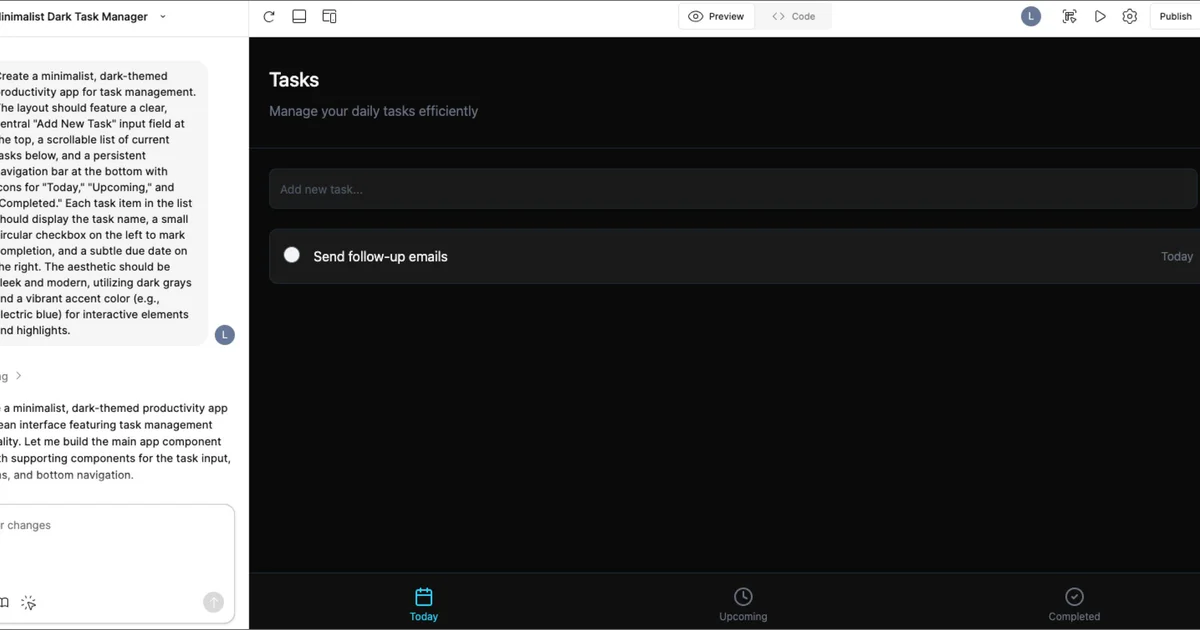
Imagine describing an app in plain English, and the AI builds the frontend, backend, tests, and even the deployment configurations. These platforms can now wire in complex backend integrations and generate comprehensive data models, logic, and access rules. This capability is a game-changer for rapid prototyping and even production-ready tools.
Leading Examples in October 2026:
- Lovable: Generates full React and Supabase codebases, perfect for non-coders needing quick web app prototypes.
- Base44: Now owned by Wix, this platform generates functional apps complete with built-in data, logic, and integrations. It uniquely creates the data model, API, login flow, and UI simultaneously.
- Vercel v0: Focuses on generating production-quality React components, a big win for developers working with modern web stacks.
- Elementor's Angie: Launched in August, this free, standalone agentic AI for WordPress uses Model Context Protocol (MCP) to understand plugins, themes, and custom post types, making WordPress development smarter.
- Meta's Muse Wonder and Muse Wonder Full: Introduced in October 2026, these frontier models are designed for personal and professional agentic tasks, including building functional applications. They are available via the Meta Model API and Muse Code.
- Other notable platforms include Zite, Emergent, Replit Agent, Cursor, Bolt, Glide, Softr, Bubble, Knack, Retool, Totalum, Anything (Create.xyz), and WeWeb.
The Shifting Role of the Developer
With AI handling more of the heavy lifting, what does this mean for human developers? Experts predict that the most valuable developers in 2027 will be those who design systems for AI to implement, rather than writing code themselves. This is a profound shift.
AI website builders can reduce development costs by 50-90% for common website types. They also cut initial production time by an average of 70%. This efficiency frees human developers to focus on higher-level problem-solving, architectural design, and ensuring the quality and security of AI-generated code.
Natalia Rachelson, Oracle's Senior Vice President of Cloud Applications Development, points out that AI empowers organizations to fundamentally rethink workflows. It transforms operational knowledge into securely built, reusable, and scalable solutions. The critical skill gap in 2026 isn't writing code, but effectively directing AI web developer tools, critically reviewing their output, and identifying errors before production.
Human judgment, strategy, and quality control remain crucial. Developers are key in addressing security vulnerabilities, accessibility, and performance issues that AI might miss. The rise of citizen developers, who now outnumber professional software developers four to one, further highlights this democratization.
Navigating the Future: Self-Hosted AI and Agent-Native Systems
The practical implications of these advancements are huge. AI website and app builders are significantly lowering the barrier to entry for creating online presences and applications. Small businesses and individuals can now launch professional-grade sites and apps in hours, without extensive technical expertise.
However, challenges persist. AI app builders can still be unreliable for complex production workloads, especially concerning persistent databases, robust authentication, and evolving requirements. AI-generated code might also contain security vulnerabilities or performance issues that demand human oversight. Long-term maintainability and code ownership are key considerations.
Looking ahead to 2027, several predictions stand out. We expect the emergence of agent-native programming languages, designed specifically for human-AI collaboration. Multi-agent economic systems are predicted to replace traditional microservices architectures, with specialized AI agents negotiating and trading expertise. Perhaps most importantly, self-hosted AI solutions are expected to become the default for many organizations.
Why TashiOS is Your AI Command Center for Digital Products
This prediction about self-hosted AI is where platforms like TashiOS shine. TashiOS is an AI-powered cloud desktop that runs on your own private VPS. It's designed for freelancers, entrepreneurs, agencies, and side-hustlers who want to build client-ready digital products without juggling many separate tools.
Imagine describing an app or website in plain English, and Skynet, the built-in AI assistant, builds it for you – no coding required. This solves a major pain point: creating and selling digital services usually means stitching together AI chat, code editors, hosting, website builders, automation tools, email platforms, and client management. TashiOS combines all of that into one cloud workspace.
A key differentiator for TashiOS is ownership. Everything you build – apps, code, and customer data – belongs to you and lives on your own server. You get full data control and no vendor lock-in. Plus, TashiOS offers predictable pricing at $49/month flat, which includes your private VPS, the cloud desktop, 25+ apps, and $150 in AI credits. This is a clear advantage over per-API-call billing from cloud AI APIs, and your prompts and data stay on your own VPS.
Ready to take control of your AI-powered development and business? Learn more about TashiOS and start your 7-day free trial today.
What's Next for AI-Powered Development
The pace of change in the AI website and app builder space won't slow down. AI agents will increasingly run, evaluate, learn, and continuously improve their capabilities autonomously. We'll see context engineering become more critical than selecting specific AI models, meaning the ability to set up the right environment and instructions for AI will be paramount.
The enterprise software landscape will also transform into an 'app-builder economy.' Businesses will use AI to build automations and agentic applications that directly address specific business outcomes. The future isn't just about AI building things; it's about AI building things that directly contribute to your bottom line, with you in the driver's seat.
The transformation we're witnessing in AI website and app builders is more than just technological progress; it's a fundamental shift in how we approach digital creation. From democratizing development to redefining the role of the developer, AI is opening up unprecedented opportunities. The ability to create, sell, and manage digital products with efficiency and full ownership is no longer a futuristic dream, but a present-day reality.
The future of digital product creation is here, and it's built on AI. Don't just observe the change, lead it. Explore how TashiOS can empower your business to create, sell, and manage digital products with unprecedented ease. Visit https://tashios.com/pricing to get started.