Imagine building a fully functional, cross-platform application in minutes, not months, using only plain English commands. This isn't a futuristic dream; it's the reality of no-code AI app building in October 2026. The market for these platforms is exploding, projected to reach USD 92.55 billion by 2036, growing at a staggering 27.0% CAGR. This rapid evolution means that if you're not exploring no-code AI, you're missing out on a powerful wave of innovation that's democratizing software development and changing how businesses operate.
The Current State of No-Code AI App Building (October 2026)
No-code AI app building has advanced significantly, moving far beyond basic prototyping. Today's tools offer robust solutions for creating functional, production-ready applications. The core developments center on enhanced AI capabilities, improved user experience, and broader integration possibilities.
Platforms now feature sophisticated AI that can generate entire applications. This includes interfaces, workflows, databases, and even native code, all from simple English prompts. This capability dramatically reduces development time and the need for specialized coding skills, opening app creation to a much wider audience.
A key shift is towards agentic automation. AI apps are no longer limited to basic chatbots. They can perform multi-step reasoning, interact with live databases, and handle complex tasks autonomously. This allows for more dynamic and intelligent applications that truly solve business problems.
Cross-platform development is also a standard feature. Many tools let you create applications that deploy across iOS, Android, and the web from a single codebase. This saves immense time and resources, ensuring your app reaches users on their preferred devices. Enhanced data integration capabilities are another crucial development, allowing seamless connections with existing data sources like spreadsheets, CRMs, and various databases.
With this increased adoption, there's a growing emphasis on governance, security, and permission systems. These features ensure compliance and oversight, which are essential for enterprise-level applications and maintaining data integrity.
Real-World Impact: Examples and Expert Views
The impact of no-code AI app building is already visible across industries, transforming how businesses and individuals approach software creation.
An expert opinion highlights this shift: "The durable trend is not 'AI replaces no-code.' It is, 'AI makes governed no-code faster.'" This quote, from ourcodeworld.com, underscores the symbiotic relationship between AI and no-code platforms. AI enhances no-code's speed and efficiency, while no-code provides the structured environment for AI to operate effectively.
We see this in action with major players. ServiceNow, for instance, launched advanced AI tools on October 15, 2026, empowering employees to build AI agents without coding. Their "ToolSmith" feature aims to reduce AI tool creation time from days to minutes, enhancing corporate governance through new credentialing and permission systems, as reported by gurufocus.com.
Google also made a significant announcement on October 13, 2026, enabling users to build personal Android apps for free using Google AI Studio. These apps run on users' own devices and can be shared with friends and family, democratizing mobile app development for everyone.
Leading platforms are also making headlines. Nativly AI and FlutterFlow were highlighted in an October 12, 2026 report as top AI app builders for their ability to create cross-platform apps from plain-English prompts. Softr was recognized on October 9, 2026, for its AI Co-Builder, which generates databases, pages, and user permissions from a single prompt. Blink.new also received a positive review on October 7, 2026, as an AI platform capable of building full-stack apps, websites, mobile apps, and AI agents from text prompts, handling database, hosting, and backend needs, according to thenextweb.com.
The Exploding Market for No-Code AI Platforms
The numbers don't lie: the no-code AI platform market is experiencing explosive growth. This surge reflects the increasing demand for faster, more accessible, and more efficient app development solutions.
- The global no-code AI platform market size was valued at USD 8.51 billion in 2026, with projections to reach USD 92.55 billion by 2036. This represents a remarkable Compound Annual Growth Rate (CAGR) of 27.0%.
- Another projection estimates the market at USD 4.88 billion in 2026, growing to USD 12.25 billion by 2031 at a 20.19% CAGR, as seen on stackademic.com.
- By 2026, 75% of new enterprise applications are expected to be built using low-code or no-code technologies, a significant jump from just 25% in 2020. This indicates a profound shift in enterprise development strategies.
- The broader low-code development technologies market is projected to reach $44.5 billion in 2026, growing at approximately 19% annually.
These statistics paint a clear picture: no-code AI is not a niche trend. It is rapidly becoming a mainstream approach to software development, driving innovation and efficiency across all sectors.
Why TashiOS for No-Code AI App Creation?
As no-code AI app building gains traction, choosing the right platform is crucial. Many tools help with one specific task, but for those looking to create, sell, and manage digital products as a recurring-income business, a comprehensive solution is essential. This is where TashiOS shines.
TashiOS is an AI-powered cloud desktop that runs on your own private VPS. It's designed for freelancers, entrepreneurs, agencies, and side-hustlers who want to build client-ready digital products without juggling many separate tools. Instead of stitching together AI chat, code editors, hosting, website builders, automation tools, and client management platforms, TashiOS combines all of that into one cloud workspace.
A key differentiator is Skynet, TashiOS's built-in AI assistant. You simply describe an app or website in plain English, and Skynet builds it for you; no coding is required. This directly aligns with the latest no-code AI developments, enabling rapid application generation from simple prompts.
Furthermore, TashiOS offers full data control. Everything you build, including apps, code, and customer data, belongs to you and lives on your own server. This eliminates vendor lock-in and provides peace of mind, a critical factor for businesses concerned about data sovereignty. With a flat monthly cost of $49, which includes your private VPS, the cloud desktop, 25+ built-in apps, and $150 in AI credits, TashiOS provides predictable expenses unlike the per-API-call billing common with cloud AI APIs. Your prompts and data stay securely on your own VPS, too.
Ready to see how AI can build and you can earn? Explore the possibilities with TashiOS and start creating your own digital products today. Your 7-day free trial awaits, with $0 charged upfront. Learn more about TashiOS and its powerful AI capabilities.
Practical Steps to Building Your First AI App
Building an AI-powered app with no-code tools is more accessible than ever. Here’s a step-by-step guide to get you started, leveraging the latest developments in October 2026.
Step 1: Define Your App Idea in Plain English
Before touching any platform, clearly articulate what you want your app to do. Think about its purpose, key features, and target users. The more specific you are, the better the AI can interpret your request. For example, instead of "I want a CRM," try "I need a mobile app for my sales team to track client interactions, schedule follow-ups, and generate daily reports, connecting to our existing Google Sheets customer database."
Practical Tip: Write down your app's core functionality, desired user interface elements (e.g., "a dashboard with sales metrics"), and any specific data points it needs to manage. This detailed prompt will be your blueprint.
Step 2: Choose Your No-Code AI Platform
Many robust platforms exist, each with strengths. Consider platforms like Nativly AI or FlutterFlow for cross-platform mobile apps, Softr for business apps and internal tools, or Glide AI for transforming spreadsheets into apps. For a comprehensive solution that helps you create, sell, and manage, consider an AI cloud desktop like TashiOS, which features Skynet, its AI assistant, to build apps from your plain English descriptions.
Practical Tip: Take advantage of free trials or starter plans to test a few platforms. Look for ease of use, relevant AI features (like agentic automation or AI-powered generation), and integration capabilities with your existing tools.
Step 3: Generate and Customize Your App with AI
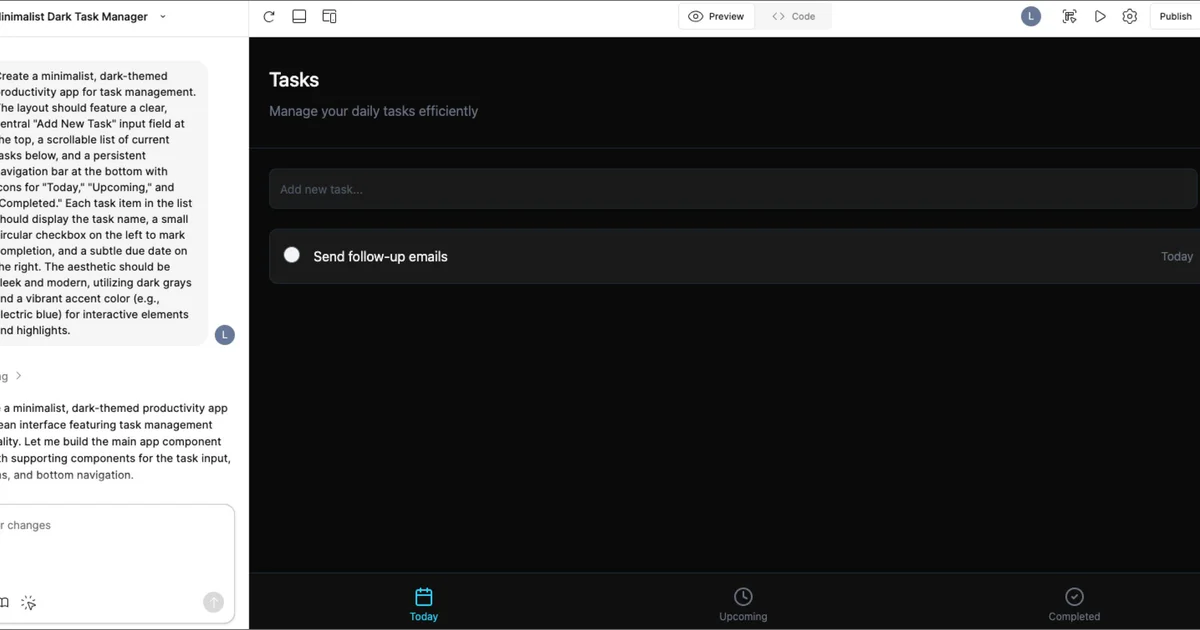
Once you’ve chosen a platform, input your detailed prompt. The AI will then generate the initial structure of your application. This might include screens, workflows, and a basic database. For example, Softr's AI Co-Builder can generate databases, pages, and user permissions from a single prompt.
Practical Tip: Don't expect perfection on the first try. Use the AI-generated app as a starting point. Most platforms offer visual editors where you can drag and drop elements, adjust layouts, and modify workflows. Refine the UI/UX to match your vision and brand.
Step 4: Integrate Data and Automate Workflows
Connect your app to any necessary external data sources. Modern no-code platforms offer enhanced data integration with spreadsheets, CRMs, marketing automation tools, and other databases. Set up agentic automation to handle multi-step reasoning and complex tasks within your app.
Practical Tip: Map out your data flow. Identify what information comes into your app, what it processes, and where it needs to send data. Use the platform's native connectors or APIs to ensure smooth data exchange. For example, if your app needs to send automated emails after a client interaction, configure that workflow.
Step 5: Test, Refine, and Deploy
Thoroughly test your app across different devices (if it's cross-platform) and with various user scenarios. Gather feedback from potential users and iterate on the design and functionality. Pay close attention to governance, security, and permission settings, especially for business applications.
Practical Tip: Start with a small pilot group to identify bugs or usability issues. Most platforms offer one-click deployment to web, iOS, and Android stores, making the launch process straightforward. Remember, the goal is a functional, production-ready application.
What's Next? Predictions for No-Code AI
The trajectory of no-code AI app building points to several exciting and transformative shifts in the coming years.
The democratization of development will continue at an accelerated pace. Individuals with deep business domain knowledge, but no coding skills, will increasingly build sophisticated applications. This empowers problem-solvers to create solutions directly, bypassing traditional development bottlenecks.
Developer roles are evolving. Instead of writing all code from scratch, developers will oversee AI-generated code, focusing on complex logic, system architecture, and ensuring robust governance and security. This shift allows human developers to tackle higher-level challenges and innovate more freely.
Scalability challenges remain a consideration. While powerful, no-code platforms can encounter limits in terms of cost scaling, latency, and data sovereignty for highly demanding, enterprise-level applications. Companies may need to transition to hybrid models, where no-code handles most of the application, but custom code or specialized services manage high-performance logic or sensitive data operations. For those prioritizing data ownership and predictable costs, platforms like TashiOS, which runs on your private VPS, offer a compelling solution.
Ultimately, AI is no longer an optional add-on; it's becoming an integral part of no-code platforms. It drives features like natural language generation, intelligent automation, and personalized user experiences, making applications smarter and more responsive. The future of no-code is deeply intertwined with AI, promising a landscape where building powerful digital tools is accessible to almost anyone.
The time to embrace no-code AI app building is now. With platforms like TashiOS, you have the tools to turn your ideas into income-generating digital products, all while maintaining full control over your data and costs. Don't just watch the future happen; build it. Ready to start building your own AI-powered apps and businesses? Explore TashiOS pricing and start your 7-day free trial today.