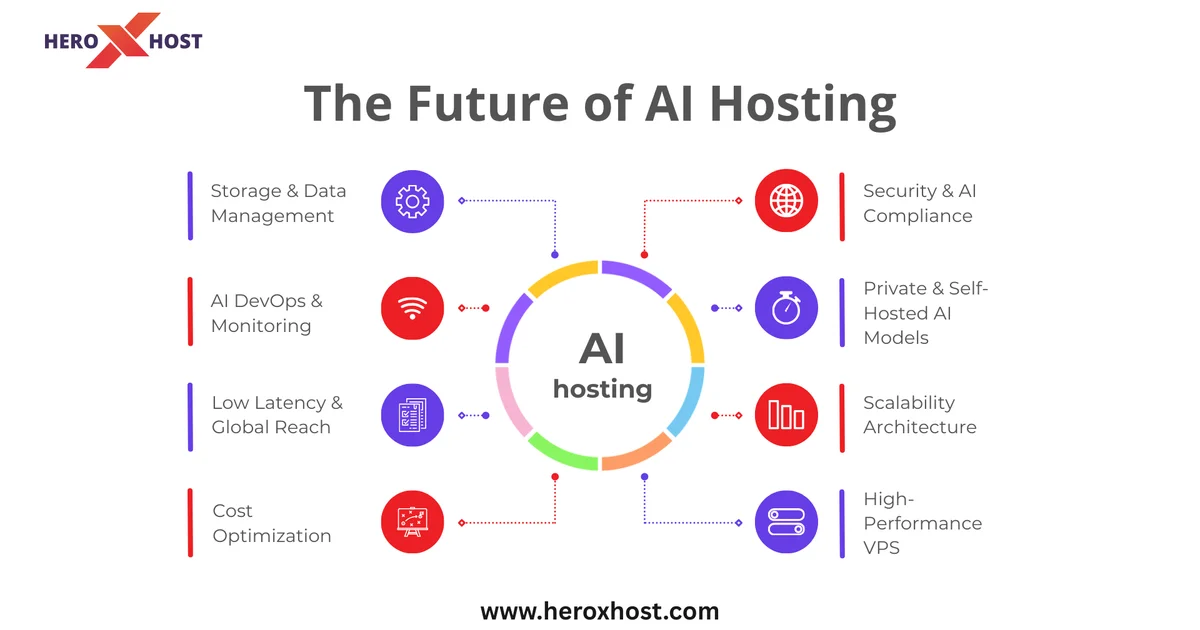
Did you know the AI Model Hosting Market was valued at USD 12.28 billion in 2025 and is projected to grow at a Compound Annual Growth Rate (CAGR) of 29.6% during 2026-2030, reaching USD 32.59 billion? This incredible growth signals a rapid transformation in how businesses and developers approach Artificial Intelligence (AI) infrastructure. Virtual Private Server (VPS) hosting for AI workloads is at the forefront of this change, driven by new GPU technology, increasing demand for accessible AI, and AI's own integration into server management.
As of July 2026, the landscape is shifting dramatically. We're seeing more powerful hardware, smarter management tools, and a clear path towards more accessible and efficient AI deployment. This overview highlights the latest developments, key market trends, and practical implications for anyone looking to build or run AI applications on their own infrastructure, perhaps even with a self-hosted AI OS like TashiOS.
1. The Ascent of High-Performance GPU VPS for AI
The availability of powerful Graphics Processing Units (GPUs) on VPS platforms has expanded significantly. This makes high-performance computing far more accessible for a wide range of AI tasks. Providers are quickly integrating NVIDIA's latest architectures, offering impressive power at competitive rates.
For instance, as of June 2026, RunPod's Secure Cloud lists NVIDIA H200 SXM at $4.39/hr and B200 at $5.98/hr. Lambda Labs offers H200 at $3.29/hr. Looking ahead, NVIDIA's GB300 systems are expected to drive most GPU shipments in 2026, with VR200-based platforms also increasing in the latter half of the year, according to gpuinsights.net. This constant refresh of hardware means more compute power for less.
Beyond the absolute cutting edge, a diverse range of GPUs caters to different AI workload needs. DigitalOcean, for example, offers NVIDIA HGX H100, H200, L40S, RTX 4000 Ada Generation, RTX 6000 Ada Generation, AMD Instinct™ MI325X, and MI300X GPU instances, as reported by digitalocean.com. RunPod provides B200, H200, H100, A100, L40, and A6000, with some options starting from $0.27 to $0.64 per hour. AMD's second generation of AI servers, featuring the MI455X AI accelerator and Venice central processor, are now in full production and expected to ship in the coming months of 2026. OpenAI even plans to use Helios racks later in 2026, according to straitstimes.com.
The market for VPS hosting for AI workloads remains highly competitive, especially for popular GPUs. An RTX 4090 can be found starting at ~$0.74/hr on RunPod, and as low as $0.30–$0.40/hr on Vast.ai for budget options, a price point noted on reddit.com. H100 rental in 2026 ranges from approximately $1.65/hour on spot and community tiers to roughly $7/hour on hyperscaler on-demand, with specialized GPU clouds offering rates around $2.00 to $3.59/hour, as seen on compute.exchange. These competitive prices make high-performance AI more accessible than ever for those using VPS solutions, including those running TashiOS.
2. AI Takes the Helm: Smart Management for Your VPS
AI is not just a workload running on VPS servers; it's increasingly being used to manage VPS environments. This leads to enhanced efficiency, stronger security, and better cost optimization. This shift represents a significant leap in server management capabilities, making VPS hosting for AI workloads even more powerful.
Intelligent scaling and predictive analytics are now standard features for many providers. AI-powered VPS management integrates machine learning and automation to predict infrastructure behavior and make dynamic adjustments. This includes predictive scaling based on 48-hour trend analysis and CPU preemptive allocation for burst traffic prediction, ensuring your resources are always optimized. For self-hosted solutions like TashiOS, this kind of intelligent management can be crucial for maintaining performance and controlling costs.
Cost optimization through FinOps is another key area. AI-driven FinOps provides real-time cost forecasting based on workload patterns and anomaly detection in billing. This helps organizations avoid unexpected resource spikes and overages, making budget management much more predictable. Furthermore, advanced security analytics saw a significant shift in Q2 2026. The implementation of AI-powered security analytics for real-time traffic analysis has led to zero-day threat detection with an average response time of 2.3 minutes and a 67% reduction in brute-force attacks across major providers. Vendors are now using machine learning to learn from actual attack vectors, moving beyond just signature matching.
3. Market Snapshot: AI VPS Growth and Adoption
The market for AI model hosting and AI servers is experiencing substantial growth, with VPS playing a crucial role in making this technology accessible. These statistics paint a clear picture of an expanding and dynamic industry.
As mentioned, the AI Model Hosting Market was valued at USD 12.28 billion in 2025 and is projected to grow at a Compound Annual Growth Rate (CAGR) of 29.6% during 2026-2030, reaching USD 32.59 billion. The year-over-year growth for 2026 alone is estimated at 27.2%. This indicates a robust and accelerating demand for platforms capable of hosting AI models, whether in the cloud or on self-hosted VPS solutions.
Global AI server shipments are forecast to grow over 28% year-over-year in 2026. GPUs will remain the leading category, accounting for 69.7% of shipments. ASIC-based AI servers are also seeing a resurgence, expected to reach 27.8% by 2026, the highest since 2023, according to techpowerup.com. This growth in specialized hardware directly supports the expansion of VPS hosting for AI workloads. Approximately 15% of businesses are now using VPS servers to deploy or fine-tune AI models, showing a clear trend towards distributed and flexible AI infrastructure.
The overall VPS market holds a 10.3% share in the broader web hosting market. Managed VPS services are growing at 16.5% per year, capturing 68.4% of revenue in 2024, as noted by colonelserver.com. This indicates a strong preference for providers to handle server management, although self-hosted solutions like TashiOS offer a compelling alternative for those who prioritize control and customization.
4. Why TashiOS is Your Go-To for Self-Hosted AI on VPS
With the rapid evolution of VPS hosting for AI workloads, many users are seeking greater control, privacy, and cost predictability. This is where TashiOS, a self-hosted AI OS for your VPS, becomes an invaluable tool. It's designed to help you build applications, automate work, and run your business directly on your own server.
One primary benefit is **complete data control and privacy**. When you self-host your AI applications with TashiOS, your sensitive data remains on your server, not in a third-party cloud. This is crucial for businesses dealing with proprietary information or operating under strict regulatory compliance. You maintain full ownership and oversight of your AI models and the data they process.
Another significant advantage is **cost predictability**. While cloud GPU instances offer flexibility, their variable billing can lead to unexpected expenses. By running TashiOS on your chosen VPS, you can better manage your infrastructure costs, especially when using dedicated GPU instances. You can run your AI agents and applications without the surprise costs often associated with hyperscalers, making budgeting much simpler. Plus, TashiOS offers **frictionless AI agent deployment** with pre-configured tooling for popular AI applications like Ollama, Flowise, AnythingLLM, LibreChat, or Activepieces. This eliminates manual setup, letting you get straight to building.
Finally, TashiOS provides unparalleled **customization and flexibility**. You have full control over your environment, allowing you to tailor it precisely to your unique AI workloads and business needs. Whether you're experimenting with new models, deploying production-grade agents, or integrating AI into complex workflows, TashiOS gives you the autonomy to configure your server exactly how you want it, making the most of your VPS hosting for AI workloads.
5. Recent Innovations and Provider Announcements
Several providers have made significant announcements in 2025 and 2026 to cater to the growing demand for VPS hosting for AI workloads. These innovations highlight the industry's commitment to making AI infrastructure more accessible and easier to manage.
A notable development came on July 1, 2026, when ABLENET introduced its AI Self-Hosted VPS. This offering is specifically designed for running AI applications like Docker, Dify, n8n, Flowise, Open WebUI, and Claude Code, providing OS templates and setup tools for quick deployment. This kind of pre-configured environment is exactly what developers using platforms like TashiOS are looking for, speeding up the time from deployment to productivity.
DigitalOcean also stepped up its game by launching GPU Droplets powered by NVIDIA H100s, now available in major US and EU regions. They've emphasized a straightforward pricing model, making powerful AI compute more approachable for their existing user base, as detailed on digitalocean.com. This move from a mainstream VPS provider signals the growing importance of GPU capabilities across the board.
Furthermore, providers are continually enhancing their core offerings. As of September 24, 2025, ABLENET increased memory for its Win5-Win7 and V5-V7 plans and introduced new Win6/Win7 and V6/V7 plans. These memory upgrades are crucial for many AI workloads, which can be quite memory-intensive. Such incremental improvements, alongside major GPU rollouts, collectively advance the capabilities of VPS hosting for AI workloads.
Ready to take control of your AI infrastructure? Explore how TashiOS can transform your VPS into a powerful, self-hosted AI command center. Build your AI applications, automate your workflows, and manage your business with complete autonomy.
6. Practical Future: What AI VPS Means for You
The developments in VPS hosting for AI workloads have several key implications, pointing towards exciting future trends. These shifts will redefine how businesses and developers interact with AI infrastructure, making it more efficient and user-friendly.
There's a growing demand for "AI VPS," which refers to standard VPS instances with pre-configured tooling that eliminates manual setup for AI workloads. Developers are looking for environments where tools like Ollama, Flowise, AnythingLLM, LibreChat, or Activepieces can run out of the box. This frictionless deployment is a critical factor for rapid innovation and adoption, a problem TashiOS directly addresses.
The rise of agentic AI is also shaping requirements. Smaller, tightly scoped models optimized for inference will support the proliferation of embedded intelligence, workflow agents, and edge decision systems. This means VPS providers need to offer flexible and scalable GPU instances to support these diverse AI agent needs, moving beyond just large-scale model training.
Looking at the market, 2026 is seeing a consolidation phase among neocloud providers as AI infrastructure demands rise. Those that can secure massive GPU allocations and deploy them quickly will gain a competitive advantage. By 2026, VPS instances with dedicated GPU capacity are expected to become a standard offering, allowing businesses to run high-performance workloads without expensive on-premise hardware. This marks a significant democratization of AI compute power.
Finally, hybrid cloud and sovereign cloud solutions are gaining traction. Private cloud solutions are increasingly supporting more stable cost models through reserved or fractional GPU allocation. Sovereign cloud initiatives are also gaining mandates as regulations sharpen and policy frameworks mature, particularly in regions concerned about data residency and control. This trend underscores the importance of flexible, self-hosted options that can adapt to varying compliance needs.
7. Leading Providers in the AI VPS Space
Several companies are at the forefront of providing VPS hosting for AI workloads, each offering unique strengths to meet diverse requirements. Understanding these key players helps in making informed decisions about your AI infrastructure.
RunPod is consistently ranked highly for its combination of price and reliability. It offers both Secure Cloud, with certified datacenter hardware, and Community Cloud, providing access to budget-friendly consumer GPUs. RunPod also provides one-click templates for popular AI frameworks like PyTorch, Stable Diffusion, and Jupyter Notebook, making deployment straightforward.
Vast.ai is known for offering some of the lowest prices in the market. You can find RTX 4090 instances appearing for $0.30–$0.40/hr, making it an ideal choice for budget-constrained experiments and development, as discussed on reddit.com. Lambda Labs, on the other hand, focuses on professional ML teams, offering H100 SXM5 clusters, high-speed InfiniBand networking, and persistent storage, justifying a premium for production workloads.
Mainstream providers are also expanding their AI offerings. DigitalOcean now offers GPU Droplets with NVIDIA H100s, H200s, and other GPUs, providing flexibility for various project scales. Vultr Cloud GPU provides NVIDIA A100 instances in major US and EU regions, appealing to developers already within the Vultr ecosystem due to its familiar control panel and object storage. CoreWeave stands out as a specialized GPU cloud provider known for renting H100 and H200 well below hyperscaler rates, often with 99.9% uptime.
Hyperscalers like AWS, Google Cloud, and Azure continue to offer a wide range of GPU options. Google Cloud Platform is unique in combining NVIDIA GPUs, including K80, T4, V100, A100, and H100, with its custom Tensor Processing Units (TPU v4, v5e). Additionally, ABLENET launched its "ABLENET AI Self-Hosted VPS" on July 1, 2026, specifically for running AI applications with pre-configured environments. Other providers like Hostinger, Hetzner, and Akamai Cloud are also recognized for their VPS offerings suitable for AI agents, with Hostinger being an overall strong contender, Hetzner great for CPU-heavy agents, and Akamai Cloud for research and web scraping.
In summary, July 2026 marks a period of significant advancement and specialization in VPS hosting for AI workloads. The market is characterized by a wider array of powerful GPUs, the integration of AI for smarter server management, and a strong emphasis on frictionless deployment and cost-effectiveness. These developments are enabling more businesses and developers to leverage AI for a diverse range of applications. The future of AI is self-hosted, flexible, and under your control. By choosing a robust VPS provider and pairing it with a powerful self-hosted AI OS like TashiOS, you're not just keeping up with the trends; you're setting them. Start building your AI-powered future today. Visit tashios.com/pricing to get started.