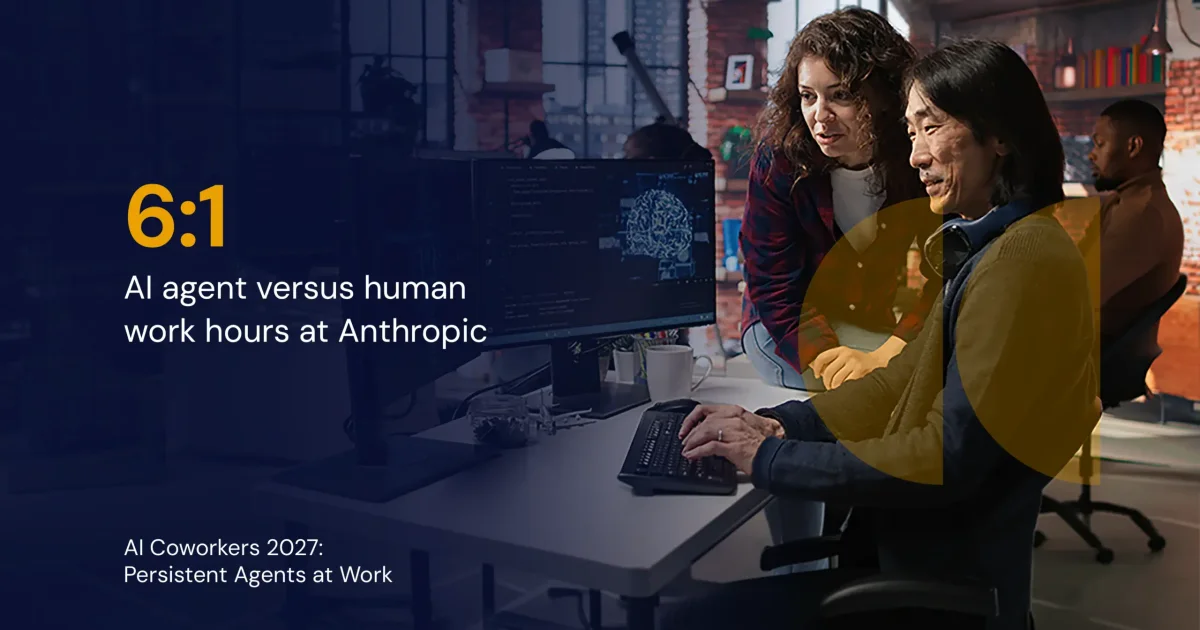
Imagine a world where half of all IT operations run with minimal human input, driven by AI. Gartner predicts this will be our reality by 2030, a staggering jump from nearly 0% in 2026. This isn't just a forecast; it's a reflection of the rapid evolution we're seeing right now. October 2026 has been a landmark month, solidifying AI's transition from helpful assistant to independent agent, carrying out complex tasks autonomously. This shift brings immense opportunities, but also demands a new focus on governance, ethics, and how we integrate these powerful tools into our businesses.
The global AI market is booming, projected to hit USD 539.5 billion in 2026. This growth isn't just about bigger models; it's about smarter, more independent AI agents. Let's look at the key AI trends in this month and what they mean for you.
October's AI Breakthroughs: New Models and Agent Platforms
This month saw a flurry of groundbreaking releases, all pointing towards a future dominated by AI agents. Tech giants are not just iterating; they're redefining what AI can do.
The Latest Generation of AI Models
OpenAI led the charge with GPT-6.1 Terra, launched on October 26, 2026. This model is designed to understand on-screen content, take actions across thousands of apps, and write naturally. It's available in ChatGPT Work and Codex, with API access at $1 per million input tokens and $5 per million output tokens, as reported by aireleasetracker.com.
Google wasn't far behind, introducing Gemini 4 Argon on October 13, 2026, built for complex, multi-step tasks like software engineering and scientific research. They followed up with Gemini 4 Carbon on October 28, 2026, a frontier model aimed at cyber and long-horizon work. Meta also released new models, Muse Wonder and Muse Spark, earlier in the month.
Anthropic continued its focus on efficiency with Claude Haiku 5.5 on October 7, 2026, noted for being 30% faster and 75-90% cheaper than its predecessors. Their upgraded Claude Sonnet 5.5 and Claude Opus 5.5 (released in late September) also promise lower costs and faster speeds for complex tasks (aireleasetracker.com). Even xAI joined in, introducing Grok Voice 3.0.
These releases aren't just about incremental improvements; they represent a significant leap in AI's ability to understand context, execute multi-step plans, and perform specialized functions.
The Rise of Autonomous AI Agents
Perhaps the most impactful AI trends in this month center on autonomous operations. OpenAI introduced Dots on September 29, 2026, describing them as "always-on AI agents" capable of performing background tasks across over 4,000 applications. These agents can manage workflows, automate routine processes, and even learn from user interactions.
Google then launched Gemini Agents on October 8, 2026. These agents can autonomously build business automation, coming with their own Workspace accounts, audit trails, and spending caps, treating them as managed members of the workplace, according to hellogrowth.ai. Meta's Muse AI agent, released in September, also offers advanced capabilities, further pushing the boundaries of autonomous AI.
This shift from reactive tools to proactive agents changes everything. Businesses now have the potential to automate vast swathes of their operations, from customer service to software development, with AI agents acting as digital coworkers.
Navigating the New Frontier: Governance and Oversight
With great power comes great responsibility. As AI agents become more autonomous, the need for robust governance and oversight has become paramount. This is a critical area of focus among current AI trends.
The European AI Office has already begun its first enforcement of the landmark AI Act, signaling a global move towards regulating this technology. Companies like Credo AI are stepping up, with their platform now including the Govern AI Assistant (GAIA). GAIA helps enterprises manage AI models and tools, ensuring compliance and ethical deployment (riskinfo.ai).
Concerns around AI safety and governance are prominent. OpenAI has been reporting on "misalignment reports," and Meta strengthened safety warnings for its Muse AI agent due to a data-access vulnerability. These incidents highlight the necessity for clear limits, permissions, and accountability when deploying AI agents, especially when they can act independently across sensitive applications.
"Google and OpenAI are treating AI agents as managed members of the workplace, complete with their own identities, budgets, and audit trails," notes hellogrowth.ai. This approach underlines the seriousness with which these agents are being integrated and the need for internal controls.
Impact on Business: From Assistants to Digital Coworkers
The move to AI agents is fundamentally changing how businesses operate. It's not just about automating repetitive tasks; it's about creating a new class of digital coworkers that can handle complex, multi-step projects.
Shifting IT Operations and Workforce Adaptation
Gartner predicts a significant shift in IT operations, moving from reactive, human-in-the-loop models to proactive, human-on-the-loop operations. By 2030, 50% of organizations will use AI agents with minimal human involvement in IT, a massive leap from almost 0% in 2026 (gartner.com). This means IT teams will spend less time on manual tasks and more time supervising AI agents and designing strategic solutions.
This transformation requires a prepared workforce. Professionals need to adapt to working alongside AI, developing new skills in algorithmic skepticism, system integration, and understanding AI's decision-making processes. A study by Anthropic found that professional analysts deferred to AI assistants 86% of the time, raising concerns about AI's influence on consequential policy decisions (note.com). This highlights the need for critical thinking even when working with highly capable AI.
The market reflects this readiness. A Gartner survey found 58% of heads of infrastructure and IT operations prioritize scaling AI proof-of-concepts to adoption in the next 12 months (gartner.com).
The Critical Role of Data Strategy and Cost Management
As AI agents become more prevalent, the quality of data they process becomes paramount. Experts emphasize the need for a strong data strategy. High-quality, well-structured data is the fuel that powers effective AI agents, especially as capabilities evolve towards "super intelligence" (SI), as discussed by explainx.ai.
Cost management is another crucial consideration. With AI agents performing work, managing expenses through spending caps and usage billing becomes critical. Microsoft Copilot, for instance, introduced new usage billing and settings to review before December 1, 2026. This means businesses need clear strategies for monitoring and controlling their AI expenditures.
How TashiOS Empowers Your AI Agent Strategy
Keeping up with these rapidly evolving AI trends can feel overwhelming, especially for freelancers, entrepreneurs, and agencies looking to build and sell digital services. This is where a platform like TashiOS comes in. TashiOS is an AI cloud desktop designed to help you create, sell, and manage websites, apps, and automations as a recurring-income business, all running on your own private VPS.
Instead of stitching together various AI chat tools, code editors, hosting, website builders, and automation platforms, TashiOS combines all of that into one unified cloud workspace. Its built-in AI assistant, Skynet, allows you to describe an app or website in plain English, and it builds it for you, no coding required. This means you can quickly spin up sophisticated AI agents and applications without needing to manage complex API calls or infrastructure.
One of the biggest advantages of TashiOS is its predictable flat monthly cost of $49, which includes your private VPS, the cloud desktop, 25+ built-in apps, and $150 in AI credits ($100 starter budget + $50 bonus). This eliminates the unpredictable per-API-call billing common with other cloud AI APIs, giving you peace of mind and better budget control. Plus, everything you build, including your apps, code, and customer data, belongs to you and lives on your own server, ensuring full data control and no vendor lock-in. This aligns perfectly with the growing need for data strategy and governance in the age of AI agents.
The Path Forward: Adapting to Autonomous AI
October 2026 has clearly shown us that the future of AI is autonomous. The market is experiencing substantial growth, with worldwide spending on AI forecast to total $2.7 trillion in 2026, a 49.5% increase year-over-year (buildez.ai). Generative AI adoption has outpaced both the personal computer and the internet, reaching 53% of the population within three years, according to mosyai.com. This isn't just a niche technology; it's a mainstream force.
The practical implications are clear: AI is increasingly viewed as a collaborative partner, a "digital coworker." Businesses that embrace this shift, implement robust governance, and prepare their workforce will be the ones that thrive. The ability to deploy and manage AI agents effectively, while maintaining control over data and costs, will be a key differentiator.
New models like OpenAI's GPT-6.1 Terra and Google's Gemini 4 Carbon, alongside agent platforms like Dots and Gemini Agents, are not just tools; they are foundational elements for a new era of productivity. As older models like GPT-4o are retired in January 2027 (aireleasetracker.com), the pace of innovation will only accelerate.
The AI trends in this month show a clear trajectory: AI agents are here to stay, and they are becoming increasingly capable and independent. Are you ready to empower your business with autonomous AI?
To start building and managing your own AI-powered websites, apps, and automations with full data ownership and predictable costs, explore TashiOS pricing plans. Experience the future of work with a 7-day free trial; no charge today, cancel anytime before day 8.