Imagine building sophisticated AI applications without writing a single line of code. In August 2026, this isn't a futuristic dream, it's the standard. Consider this: 70% of all new enterprise applications are now built using low-code or no-code technologies. This dramatic shift signals a new era for innovation, driven by accessible AI.
The no-code AI app building revolution is fundamentally reshaping how businesses and individuals approach intelligent application development. Thanks to advancements in AI, especially large language models (LLMs) and agentic AI, powerful capabilities are now within reach for non-technical users. Let's explore the current state, key trends, and future trajectory of this dynamic market.
The Explosive Growth of No-Code AI App Building in August 2026
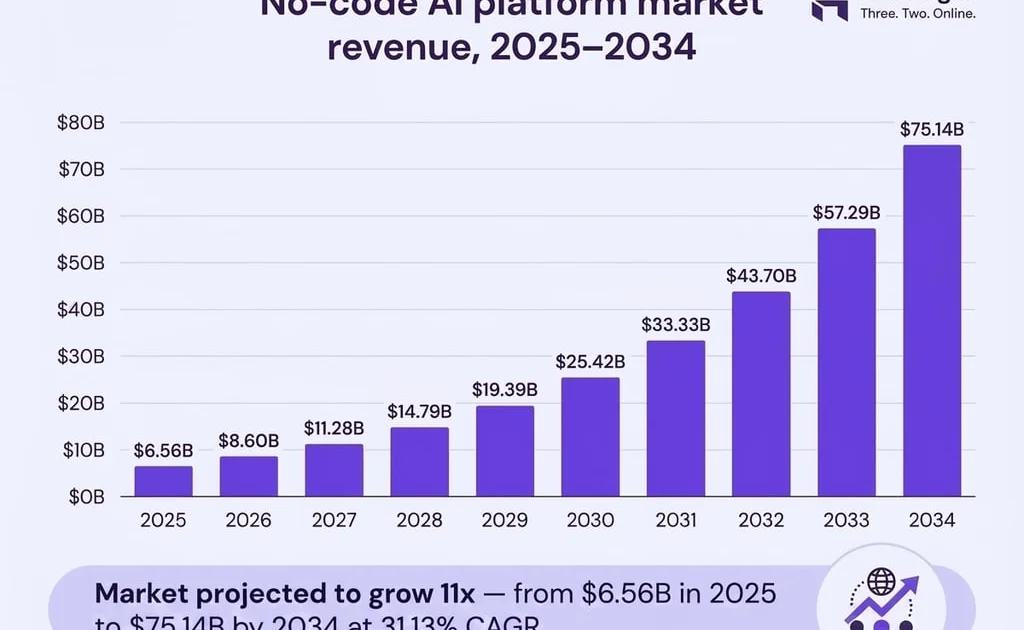
The no-code AI platform market is undergoing a dramatic expansion. Valued at approximately $6.56 billion in 2025, it's projected to reach $8.6 billion in 2026 and soar to an astounding $75.14 billion by 2034. This demonstrates a compound annual growth rate (CAGR) of 31.13% during this forecast period, according to fortunebusinessinsights.com.
Other estimates place the no-code AI platform market at $4.88 billion in 2026, growing from $4.06 billion in 2025, with projections reaching $12.25 billion by 2031 at a 20.19% CAGR (mordorintelligence.com). The broader low-code development technologies market, as estimated by Gartner, is around $44.5 billion in 2026, growing at about 19% annually.
This growth is fueled by AI's profound impact on development speed and efficiency. As of January 2026, 90% of developers regularly use at least one AI tool at work. AI tools can accelerate coding tasks by 55% in controlled experiments. Approximately 46% of all new code is now AI-generated, a significant jump from about 10% in 2023.
The market has also seen a bifurcation. We're seeing AI prototype generators that quickly produce "throwaway" apps, alongside governed platforms designed to run real, owned, and compliant applications at scale. The durable trend is clear: AI makes governed no-code faster, rather than AI replacing no-code entirely.
Agentic AI and LLMs: Powering the Next Generation of Apps
Agentic AI, which refers to systems capable of thinking, planning, and acting independently, is a major focus in 2026. Gartner projects that 40% of enterprise applications will be integrated with task-specific AI agents by the end of 2026, up from less than 5% in 2025. The AI agent market reached $7.84 billion in 2025, and multi-agent enterprise deployments have surged by 327% in the last four months alone, as of July 2026.
The latest generation of no-code AI platforms is transformative due to the deep integration of large language models (LLMs). Modern platforms like Dify, FlowiseAI, and Langflow allow users to describe their desired application in natural language. The platform then generates the entire application, including document ingestion, vector search, and conversation management.
OpenAI's GPTs and Assistants API have also evolved into a GUI-based no-code platform. This enables users to create robust AI applications using natural language instructions. Real-world examples include Lindy AI for business automation and lead qualification, and Airtable's Omni, a conversational AI builder launched in 2025, allowing users to describe workflows and internal tools in natural language. Taskade Genesis has seen over 150,000 apps built by July 2026, showcasing this trend (taskade.com).
The Rise of Citizen Developers and Enterprise Adoption
The rise of "citizen developers" is a defining trend. A striking 63% of AI app builder users have no coding background. Citizen developers now outnumber professional software developers roughly four to one, estimated at 100-120 million versus 27.7 million professionals. Gartner projects that 80% of low-code users will be non-programmers.
This democratization of AI is dismantling the historical bottleneck of specialized programming and machine learning expertise. It makes AI application development accessible to business users who best understand the problems. This shift empowers anyone, from founders and marketers to business owners, to build, train, and deploy machine learning models and AI-powered applications without writing code.
Enterprises are rapidly adopting these tools. By 2026, 70% of new enterprise applications are expected to use low-code or no-code technologies, a substantial increase from less than 25% in 2020. This forecast is now seen as a description of the current state of enterprise development. In fact, 77% of U.S. small and midsize businesses regularly use AI in 2026 (hostinger.com).
No-code platforms can cut development time by up to 90% (caspio.com), leading to significant cost reductions. A remarkable 91.9% of no-code projects recover their investment within the first year. This efficiency and accessibility are crucial for bridging the global shortage of over 1.5 million AI professionals, abstracting technical complexity behind visual interfaces and pre-built components.
Navigating the Challenges: From Prototypes to Production
Despite the excitement, the no-code AI app building space faces significant challenges as it matures. One major concern is developer trust in AI output. While AI-generated code is increasing, developer favorability decreased to 60% in 2025, down from 77% in 2023.
Many AI-powered no-code app builders, such as Lovable and Bolt.new, are impressive for the initial 80% of a project. However, the final 20% often presents significant challenges. This "last 20%" problem, which turns a demo into a production-ready product, can be costly due to AI debugging loops.
Generating functionally correct code is one hurdle; generating secure, scalable, and maintainable backend systems remains difficult. Governance is another critical area. Forrester highlights that while AppGen and low-code platforms expand development capacity, they also introduce fragmentation and complexity. Prioritizing creation without governance can lead to duplication, risk, and long-term issues.
Gartner projects that by 2026, over 70% of enterprise AI implementations will include a no-code or low-code orchestration layer, emphasizing the need for responsible scaling of AI. Platforms like Microsoft Power Apps + AI Builder, Google Vertex AI, and IBM watsonx.ai are focusing on embedding AI in business apps, offering AutoML, prompt orchestration, and robust governance features for regulated industries.
The market itself shows high stakes, with SpaceX acquiring Anysphere, the maker of Cursor, for $60 billion in June 2026. Lovable is also reportedly in talks to raise at a $13.2 billion post-money valuation. These figures underscore the immense value in AI-first code generation, but also the complexity of delivering production-ready solutions at scale.
Why TashiOS is Your AI App Building Command Center
For entrepreneurs, freelancers, and agencies, the promise of no-code AI app building often comes with the headache of juggling multiple tools, managing disparate hosting, and facing unpredictable cloud API costs. This is where TashiOS steps in, offering a unique solution designed to overcome these very challenges.
TashiOS is an AI cloud desktop for creating, selling, and managing websites, apps, and automations as a recurring-income business. It runs on your own private VPS, giving you full data control and preventing vendor lock-in. Everything you build, including your apps, code, and customer data, belongs to you and lives on your server.
Imagine simply describing an app or website in plain English to Skynet, the built-in AI assistant. Skynet builds it for you, with no coding required. This directly addresses the need for accessible AI app building for citizen developers, while also providing a governed environment for production-ready products. Unlike per-API-call billing from cloud AI APIs, TashiOS offers a predictable flat monthly cost of $49. This includes your private VPS, the cloud desktop, 25+ built-in apps, and $150 in monthly AI credits ($100 starter budget + $50 bonus).
If you're ready to move beyond prototypes and build client-ready AI solutions with full control and predictable costs, TashiOS offers a powerful, all-in-one solution. It's built for those who want to create, sell, and manage digital products without stitching together countless separate tools.
What's Next for No-Code AI? Predictions for the Future
The no-code AI app building landscape will continue its rapid evolution. We can expect several key trends to shape its future. First, there will be a strong focus on developing leaner AI models. This is driven by hardware limitations and cloud costs, making advanced AI solutions more accessible with lower resource requirements.
Multimodal generative AI will become increasingly prevalent. These systems will process multiple data types simultaneously, leading to more organic and intuitive user interactions. The popularity of open-source frameworks, like TashiOS's OpenClaw runtime, will also increase. This allows companies to customize AI models without significant infrastructure investments.
A significant shift is expected in user interfaces. Within 12 months, AI-generated user interfaces are expected to be indistinguishable from hand-crafted ones for most use cases. This will shift the differentiation to backend capability and production reliability, emphasizing the importance of robust, governed platforms.
Expect deeper AI integration across the entire application lifecycle, stronger governance features, and broader integrations with existing software stacks. AI-assisted development will continue to shape the next phase of platform growth. The emphasis is shifting from raw generation to production endurance, requiring evaluation-led development and stringent data governance to prevent the failure of AI pilot programs.
The era of the citizen developer is here, and AI is its engine. The no-code AI app building market in August 2026 is a vibrant ecosystem of innovation, empowering more people than ever to create intelligent applications. For those ready to build, sell, and manage their own digital products with unprecedented ease and full ownership, TashiOS offers a powerful, all-in-one solution. AI builds. You earn.