Imagine building a complete website draft in just 15 minutes. This isn't a futuristic fantasy; it's the reality of August 2026. The average time to produce a website draft has dramatically dropped from a full work week to mere minutes, a testament to the rapid evolution of AI website and app builders. These tools are not just improving; they are fundamentally reshaping how we conceive, create, and manage digital experiences. AI is no longer a simple add-on; it is now the foundational layer of web and app development infrastructure.
This comprehensive overview explores the latest developments in the AI website and app builder market in August 2026, highlighting key innovations, market trends, and the evolving role of human expertise. We will look at who is leading the charge, the surprising growth statistics, and what this all means for entrepreneurs and developers.
The AI Revolution in Web Development: Beyond Automation
The past year, from 2025 to 2026, has marked a pivotal shift in how we approach web and app creation. AI is deeply embedded in every stage of development, offering capabilities far beyond simple automation. Modern AI tools are now standard for generating code snippets, suggesting bug fixes, detecting security vulnerabilities, and even automatically generating documentation. This generative AI analyzes project specifications to write code, significantly reducing development time and allowing creators to focus on higher-level design and strategic decisions.
One of the most impactful changes is the rise of personalized user experiences (UX). AI enables websites to recommend products, display custom content, adapt layouts for different users, and predict customer behavior. This leads to improved customer engagement and more effective digital platforms. Automated design and layout generation has also moved beyond reliance on pre-designed templates. AI website builders can now automatically generate responsive layouts, optimize user interfaces, and create unique designs tailored to a brand's identity and keywords.
The market is seeing a rise in "AI-native" platforms, designed with AI as the primary building interface. Users describe an outcome in plain language, and the platform handles architecture, data connectivity, security, and deployment. Examples include platforms like Atoms, Bolt, Lovable, and Replit Agent, which aim to generate complete applications from natural language descriptions. This shift is why platforms like TashiOS, an AI-powered cloud desktop for your own VPS, are so relevant. It combines all the tools you need to create, sell, and manage digital products, moving beyond single-task AI solutions by providing an integrated workspace.
Beyond site creation, AI builders are expanding into all-in-one business solutions. They incorporate features like CRM, invoicing, AI marketing tools, and analytics directly into their platforms. This integration streamlines operations for businesses of all sizes. The impact on development cycles is clear: the average time to publish a website decreased by 50% between 2025 and 2026, from 8 days to just 4 days, with initial drafts often ready in minutes.
Key Players and Breakthroughs: Who's Leading the AI Builder Race?
Several platforms are at the forefront of this AI-driven transformation, each bringing unique innovations to the market. Their recent developments highlight the rapid pace of change in the industry.
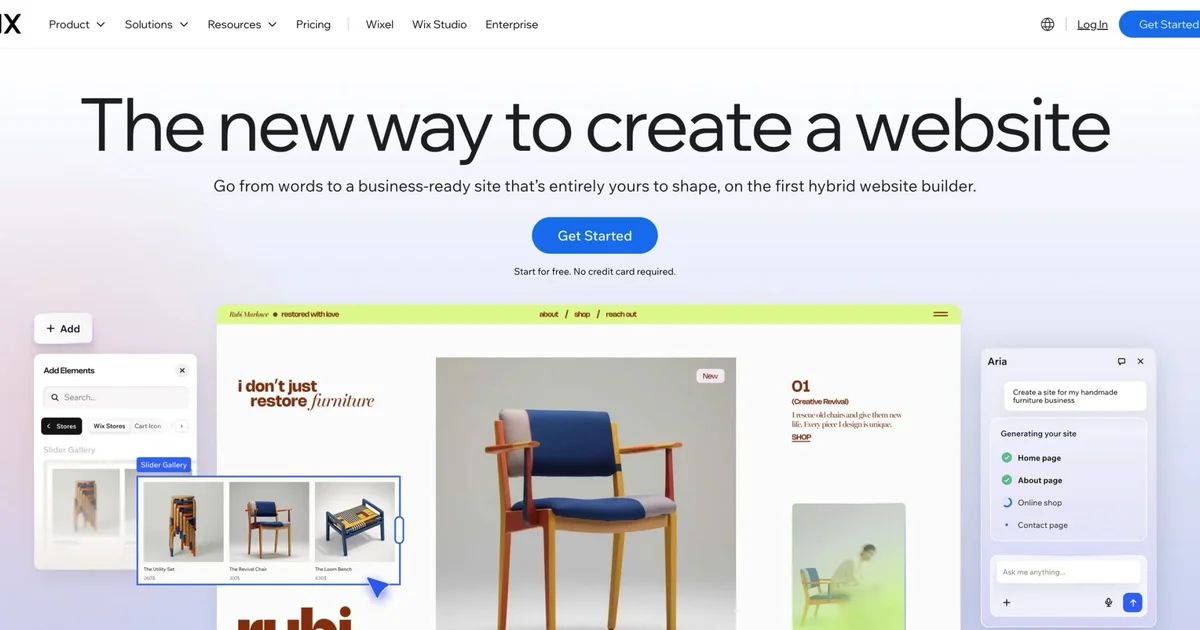
- Wix: This veteran in website building has embraced AI with over 20 unique AI features. Their Wix AI Website Builder, Wix Studio AI, and AI text/image creators are popular. The AI agent "Aria" assists with design, technical tasks, and copywriting, while Wix Harmony allows manual fine-tuning of AI-generated sites. Wix was rated a top AI website builder in 2025 (kgkrunch.com).
- Squarespace: Named one of TIME's Best Inventions of 2025, Squarespace features a "Design Intelligence" suite. This includes Blueprint AI Builder, an AI-powered design partner, and Beacon AI, an assistant for optimizing business growth. Squarespace GPT provides a unique starting point for website building, complemented by AI content generation and AI SEO Optimization. Their "Squarespace Refresh 2025" in September 2025 rolled out significant enhancements with a strong emphasis on practical applications for unique website building and business growth (synaptech.io).
- Durable AI: Known for generating a complete, professional website in approximately 30 seconds, Durable AI has seen over 3 million business owners use its platform since its 2022 launch. In March 2026, Durable expanded into an "all-in-one AI business builder," bundling website creation with a lightweight CRM, invoicing, an AI content writer, and marketing helpers under a single subscription (synaptech.io).
- Hostinger Horizons: This platform has seen over one million users build websites and web apps, with an impressive 93-95% being first-time website builders, underscoring AI's role in democratizing web creation (hostneverdie.com).
- Atoms: A no-code AI platform, Atoms deploys AI agents to handle every stage of product building, from market research to deployment.
- "Vibe Coding" Tools: Platforms like Lovable, Bolt, and Replit Agent are generating actual, exportable React/HTML code from plain English descriptions. Lovable, an AI-first code generation platform, was reportedly in talks to raise at a $13.2 billion valuation with over $500 million in Annual Recurring Revenue (ARR) in July 2026 (vybe.build).
Even major tech companies are making moves. SpaceX acquired Anysphere, the maker of the AI coding tool Cursor, for $60 billion in June 2026. This acquisition highlights the strategic importance of AI in software development, even for companies outside traditional tech.
Market Momentum: Explosive Growth and Adoption Rates
The AI website and app builder market is not just innovating; it is experiencing explosive growth, reflecting a significant shift in business and development practices. The global AI-powered website builder market was valued at $2.69 billion in 2025 and is projected to reach $3.24 billion in 2026, growing to an estimated $17.43 billion by 2035 at a Compound Annual Growth Rate (CAGR) of 20.55% (synaptech.io).
This growth is fueled by massive investment in AI across sectors. Worldwide AI spending is expected to hit $2.52 trillion in 2026, a 44% year-over-year increase, accelerating the development of AI-native tools (synaptech.io). Small businesses are rapidly adopting generative AI, with 58% now using it, a significant increase from just 23% in 2023. This shows AI's immediate, practical value for everyday business operations (techsolutionor.com).
Developers are also embracing AI at an unprecedented rate. An impressive 84% of developers use or plan to use AI coding tools. Major tech companies are already generating 30-90% of new code with AI, demonstrating its profound impact on productivity (synaptech.io). Developers report completing common, repetitive tasks about 55% faster with AI (synaptech.io). This efficiency translates into significant cost reductions, as AI website builders are disrupting traditional pricing models, reducing costs by 50-90% for common website types, with typical AI-powered website builder subscriptions ranging from $15-$50 per month.
Cloud-based tools dominate the market, accounting for approximately 81% of the market share. Small and Medium Enterprises (SMEs) drive nearly half of all revenue at 49%, indicating that AI builders are particularly beneficial for smaller operations (firebearstudio.com). North America currently holds approximately 43% of the global AI website builder market share, leading the adoption curve.
The Shifting Role of Developers: From Coders to Architects
A common misconception is that AI will replace human developers. However, the expert consensus in 2026 is clear: AI is augmenting developers, not replacing them. While AI automates repetitive tasks like generating boilerplate code or debugging, human developers remain crucial for problem-solving, system architecture, business logic, user experience strategy, and security planning. The developer role is shifting from typing syntax to prompt engineering and system architecture, requiring a different set of skills.
Experts emphasize that successful organizations in 2026 will combine technology, creativity, and human expertise. The focus for developers is now on security, performance, and the intricate business logic behind the site (synaptech.io). As one expert stated, "AI is fundamentally transforming web development in 2026. From generative coding and real-time testing to voice-enabled navigation, edge AI, and predictive personalization, every aspect of website creation is being optimized for speed, efficiency, and user engagement." (synaptech.io)
Despite the immense benefits, a significant challenge remains: the "almost right" nature of AI-generated code. A staggering 66% of developers cite near-correct answers as their biggest frustration (hostneverdie.com). This can lead to increased time spent fixing AI output and accumulating technical debt. Over 40% of AI-generated code may also carry hidden vulnerabilities, underscoring the critical need for human oversight and rigorous testing.
This evolving landscape means developers and entrepreneurs need tools that offer both powerful AI capabilities and control. If you are looking to build client-ready digital products with full data ownership and predictable costs, explore what TashiOS can do for you. It provides a comprehensive workspace where you can manage both AI-driven creation and the critical human oversight needed for quality and security.
Why TashiOS is Your AI-Powered Business Command Center
In a world of rapidly advancing AI tools, entrepreneurs, freelancers, and agencies often face the challenge of stitching together disparate platforms. Creating and selling digital services typically involves juggling AI chat, code editors, hosting, website builders, automation tools, email platforms, and client management solutions. This fragmented approach can be inefficient and costly.
TashiOS solves this very problem by providing an AI-powered cloud desktop that runs on your own private VPS. It is an AI cloud desktop for creating, selling, and managing websites, apps, and automations as a recurring-income business. Instead of paying for multiple subscriptions and dealing with complex integrations, TashiOS bundles your VPS, the OS, and monthly AI credits into one flat subscription.
Our built-in AI assistant, Skynet, is a key differentiator. You simply describe an app or website in plain English, and Skynet builds it. No coding is required. This empowers users to rapidly prototype and deploy digital products, whether they are experienced developers or first-time builders. What's more, everything you build, including apps, code, and customer data, belongs to you and lives on your own server. This provides full data control and eliminates vendor lock-in, a crucial concern in the age of cloud services.
TashiOS ships with 25+ built-in apps and tools for building, automating, and running an online business. This comprehensive suite means you are not just getting an AI builder, but an entire ecosystem designed to help you create, sell, and manage digital products efficiently. With a predictable flat monthly cost of $49, which includes your private VPS, cloud desktop, 25+ apps, and $150 in AI credits ($100 starter budget + $50 bonus), TashiOS offers a clear financial advantage over per-API-call billing models from cloud AI APIs.
What's Next? Predictions for Hyper-Personalization and Autonomous Systems
Looking ahead, the trajectory of AI website and app builders points towards even more advanced capabilities and a deeper integration into the fabric of digital operations. Future trends indicate a move towards autonomous site builders that can design, code, test, and deploy fully functional websites with minimal human input. Imagine AI agents managing multi-step development tasks independently, from initial concept to live deployment.
AI-driven design feedback loops are expected to become standard, continuously analyzing user interactions to suggest instant UX improvements. This means websites will not just be built by AI, but will also evolve and optimize themselves in real-time based on actual user behavior. AI will continuously monitor website performance, update weak pages, optimize layouts automatically, and even rewrite content based on real search behavior, ensuring perpetual relevance and effectiveness.
The impact on small businesses will continue to be profound. AI website builders are democratizing web development, enabling small businesses and first-time builders to launch professional sites in hours rather than weeks. This closes the gap for businesses without an online presence, leveling the playing field. AI is becoming an invisible, embedded layer across all digital operations, from enterprise tools to customer experiences and product decisions.
The interaction between websites and AI is also evolving. AI search platforms receive over 8 billion visits a month in 2026. Websites are increasingly communicating with AI agents and informing Large Language Model (LLM) outputs, although LLMs currently account for less than 1% of direct site traffic (wedoflow.com). This suggests a future where websites are not just destinations but active participants in the broader AI ecosystem.
Finally, the low-code/no-code evolution will continue to empower non-technical teams. However, hybrid approaches combining low-code for internal tools with custom code for core products will become more common. This balances the need for speed and accessibility with the flexibility and performance required for critical, bespoke applications.
August 2026 showcases an AI website and app builder market that is robust, rapidly expanding, and fundamentally reshaping how digital products are conceived, built, and maintained. The emphasis is on intelligent automation, personalization, and integrated business functionalities. While AI provides unprecedented speed and efficiency, the evolving, yet indispensable, role of human expertise remains central to ensuring quality, security, and strategic vision. The future is bright for those who embrace these powerful tools.
The future of digital creation is here, and it's powered by AI. Don't just adapt to this new era; lead it. Discover how you can create, sell, and manage your digital products with unparalleled efficiency and control. Visit TashiOS Pricing to start your 7-day free trial today and experience AI that builds, so you can earn.